


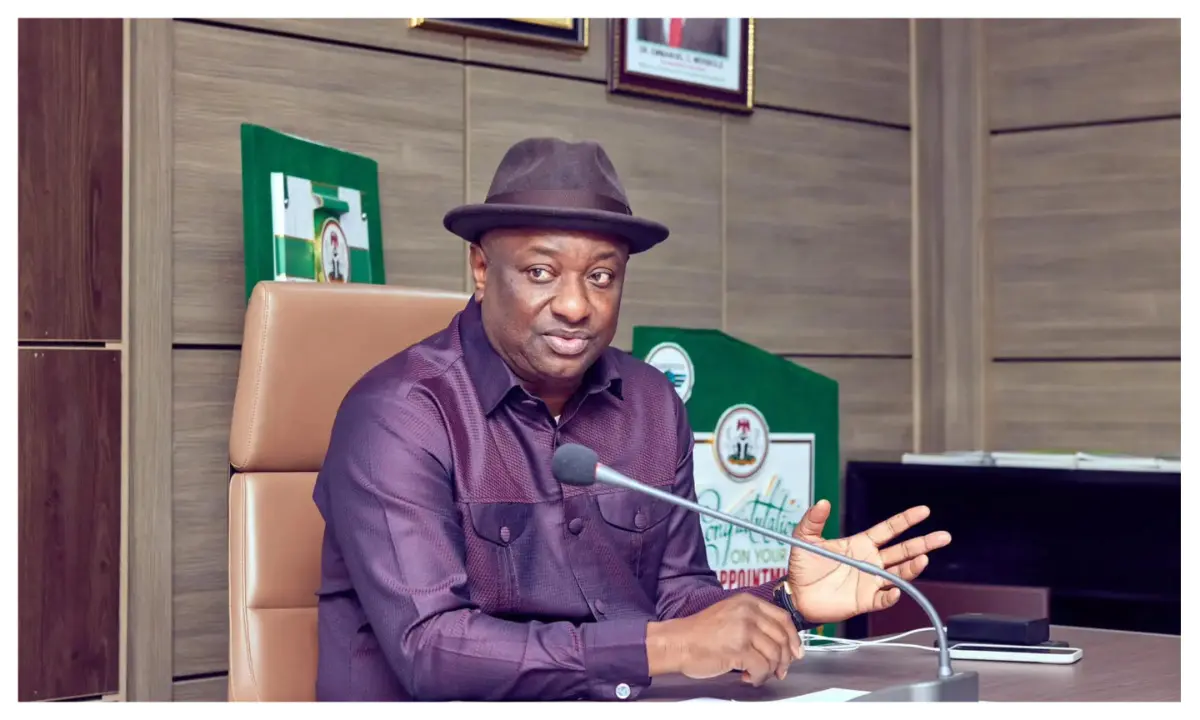
Nigeria’s Minister of Aviation and Aerospace Development, Festus Keyamo, has sharply criticised a group of prominent opposition politicians who staged a protest in Abuja, accusing them of attempting to “blackmail” institutions and the public.
The demonstration, held on Wednesday morning, saw high-profile political figures including Atiku Abubakar, Peter Obi, Rabiu Kwankwaso, Rauf Aregbesola, Rotimi Amaechi, and Aminu Tambuwal taking to the streets with banners of the African Democratic Congress (ADC). The protest was organised under the banner “Save Our Democracy”.
The protest follows a controversial decision by the Independent National Electoral Commission (INEC) to de-recognise the leadership faction of the ADC headed by David Mark. The move has triggered political tension and raised questions about internal party disputes and electoral oversight.
Reacting via social media platform X, Keyamo questioned the basis of the protest, suggesting that the demonstrators were exaggerating the implications of INEC’s decision. He argued that Nigeria’s democratic stability could not be tied to the recognition of a single faction within one of the country’s many registered political parties.
Keyamo further pointed out that the faction in question had failed to secure electoral success, referencing its inability to win even a single council seat in the recent Federal Capital Territory (FCT) elections. According to him, this undermines the claim that the faction represents a significant democratic force.
In a strongly worded statement, the minister accused the protesting politicians of attempting to impose their narrative on the public while disregarding due judicial processes. He suggested that their actions were aimed at pressuring institutions into compliance, warning that such tactics would not succeed.
“Unfortunately for them, Nigerians are not so gullible,” Keyamo stated, dismissing the protest as an effort to manipulate public perception.
The development highlights ongoing tensions within Nigeria’s political landscape, particularly concerning party leadership disputes and the role of electoral authorities.
As the situation unfolds, observers are watching closely to see whether the matter will be resolved through legal channels or continue to play out in the public arena.

