


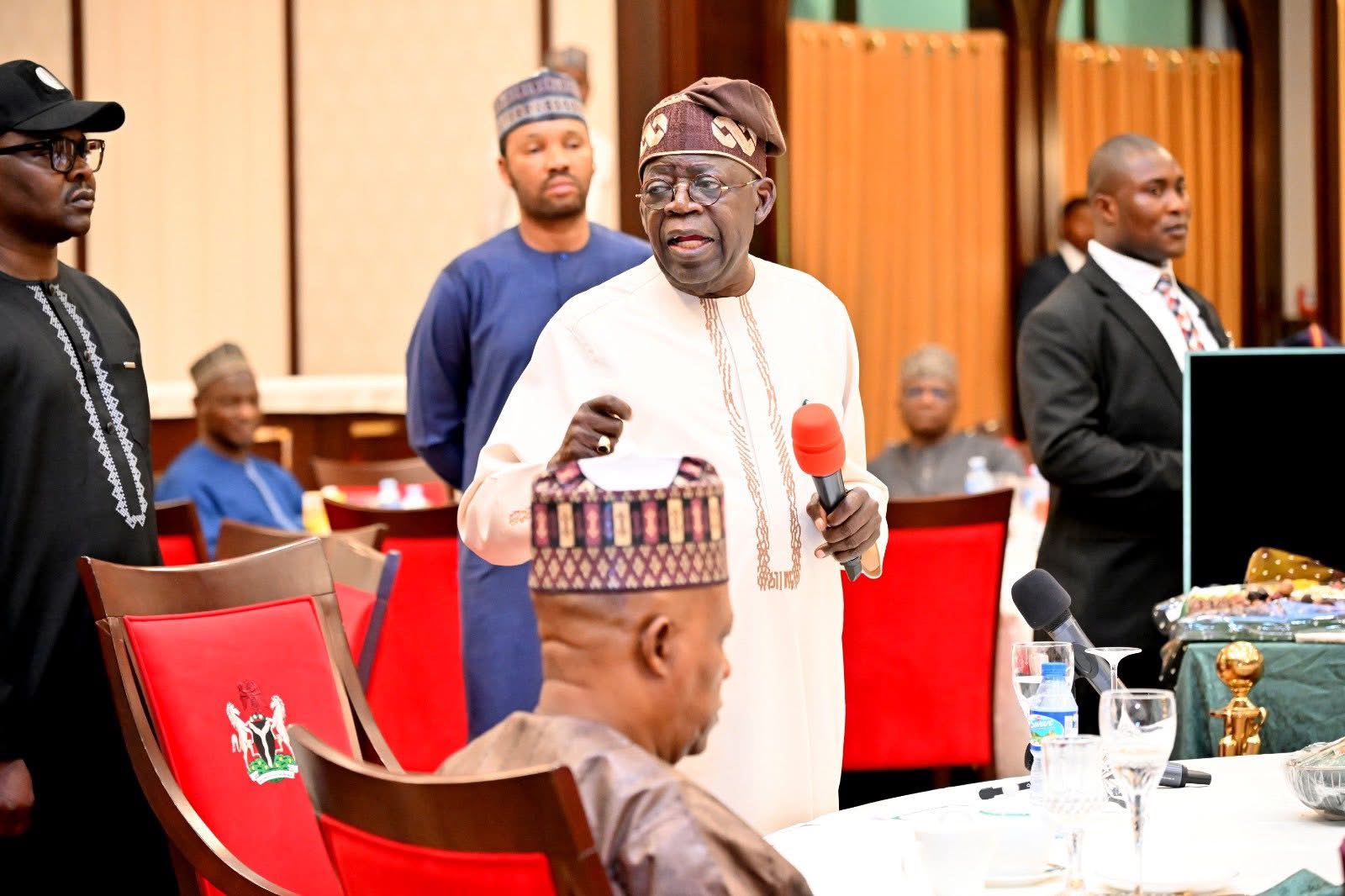
President Bola Tinubu has urged state governors and religious leaders to place the needs of the poor and underprivileged at the centre of governance, stressing that compassion and development must cut across religion, ethnicity, and social status.
The statement was issued on Monday by Bayo Onanuga, Special Adviser to the President on Information and Strategy, while holding interfaith breaking of fasting at the state house.
READ MORE: Kogi youths raise N100m to secure Tinubu’s 2027 presidential nomination form
CDS Oluyede launches operation Savannah shield to tackle insecurity in Kwara, Niger
The Muslims holy month of Ramadan coincides with the Christian season of Lent.
Tinubu said the simultaneous periods of fasting and penitence underscored a shared humanity and offered leaders an opportunity to reflect on policies that directly improve livelihoods at the grassroots.
“It is a joy and great honour to be with you again this year, to give thanks to the Almighty God for sparing our lives and keeping us together to see another Ramadan,” the President said.
He added that the coincidence of Ramadan and Lent symbolised “discipline, sacrifice, faith, resilience, and strong determination to continue to bridge together, pray together, and love one another.”
The President noted that while progress had been recorded, more needed to be done to reduce poverty and empower young people. “Tolerate everybody and build structure in this period of faith, unity, harmony and sacrifice that you are experiencing. Let the young ones breathe too,” he said.
Tinubu welcomed Abba Kabir Yusuf to the State House and made light remarks about political differences, urging leaders to temper justice with mercy. He also commended Babagana Zulum for what he described as inclusive Ramadan outreach to both Muslims and Christians in Borno State.
“I must refer to the generosity of Prof. Zulum. I saw the layout of the Ramadan outreach for both Christians and Muslims. That is a very good spirit,” Tinubu said.
The President further praised governors for their commitment to development but appealed for broader inclusion. “Let it be all-encompassing so that we can spread the development opportunity across to the grassroots and local governments,” he said, adding that “the reward of hard work is more work,” including for Mohammed Umar Bago, whom he described as “the farmer from Niger State.”
On the economy and security, Tinubu said Nigeria was emerging from a difficult period. “We are out of the woods. Out of the dark tunnel of uncertainty. The economy is showing up. Let’s help the unemployed,” he said.
He reaffirmed his administration’s commitment to establishing state police to combat insecurity. “Security is the foundation of prosperity. Without it, farms cannot flourish, businesses cannot grow, and families cannot sleep in peace,” the President said. “We will establish state police to curb insecurity. This is not about politics. It is about practicality.”
Tinubu emphasised that governance must be people-centred. “Development must not recognise religion. Compassion must not recognise tribe. Opportunity must not recognise status,” he said, adding that his administration remained determined to deliver on its promises to Nigerians.
Speaking on behalf of the Nigeria Governors’ Forum (NGF), Hope Uzodimma, Governor of Imo State, commended the President for promoting national unity amid religious and ethnic tensions. Uzodimma described the coincidence of Ramadan and Lent as divinely inspired.
“It is not often that the Muslim Ramadan fast coincides with the Lent season. The last time was 33 years ago,” he said. “This convergence is a special situation created by God to remind us Christians and Muslims not to allow religious and ethnic differences to guide our thoughts and our political activities.”
Uzodimma also praised Tinubu’s leadership and collaboration with governors, noting that the interfaith gathering reflected a commitment to supporting the less privileged during the fasting period.

