


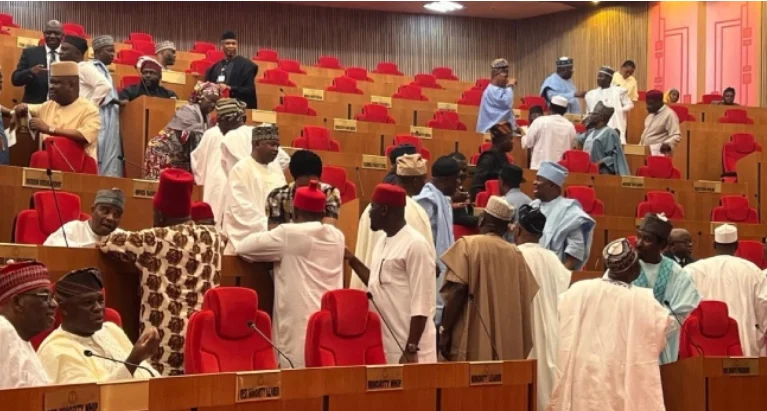
The Nigerian Senate was thrown into confusion on Tuesday as lawmakers reconvened to revisit their earlier decision on the electronic transmission of election results contained in the Electoral Act Amendment Bill, 2026.
The proceedings became rowdy shortly after the Senate Chief Whip, Senator Tahir Monguno (APC, Borno North), raised a point of order seeking the rescission of the chamber’s prior approval of Clause 60(3) of the bill. Monguno based his request on Orders 1(b) and 52(6) of the Senate Standing Orders, 2023 (as amended), and was seconded by Senator Abdul Ningi (PDP, Bauchi Central).
However, the motion immediately sparked tension, with several senators raising points of order in protest. Trouble escalated when Monguno moved his motion and read Clause 60(3) without the phrase “real-time,” replacing the word “transmission” with “transfer.”
Senator Enyinnaya Abaribe (APGA, Abia South) strongly objected, repeatedly raising points of order as the chamber descended into shouting and confusion. According to the Senate Committee on Electoral Matters’ report, Clause 60(3) originally states:
“The Presiding Officer shall electronically transmit the results from each polling unit to IREV portal in real time and such transmission shall be done after the prescribed Form EC8A has been signed and stamped by the Presiding Officer and/or countersigned by the candidates or polling agents available at the polling unit.”
At the height of the disagreement, Abaribe invoked Order 72 of the Standing Orders, calling for a division. Senate President Godswill Akpabio then asked whether Abaribe would proceed with his request for a vote. After a brief moment of confusion, Abaribe withdrew his point of order calling for a division.
Tuesday’s extraordinary sitting came less than a week after the Senate passed the Electoral Act Amendment Bill, 2026, amid growing public pressure from civil society organisations, opposition leaders, labour unions, professional bodies, regional leaders, and youth groups demanding the retention of real-time electronic transmission of results. Protesters have taken their grievances to the gates of the National Assembly, voicing concerns about transparency and electoral credibility.
The session, presided over by Akpabio, was attended by 105 senators, down from the full complement of 109. The emergency sitting had been formally announced on Sunday in a statement by the Clerk of the Senate, Emmanuel Odo, scheduling plenary to commence at 12 noon.
Observers say the chaotic session highlights deep divisions within the Senate over Clause 60(3) and underscores the intensity of public and political scrutiny surrounding Nigeria’s electoral reforms ahead of the 2027 general elections.

