


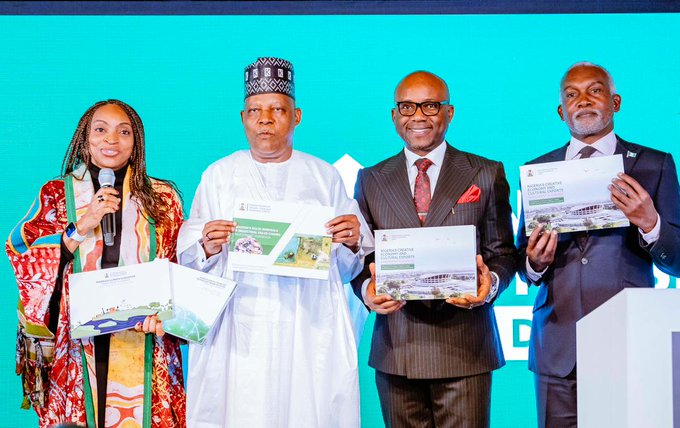
Nigeria has marked a historic turning point in its global economic diplomacy with the official commissioning of the “Nigeria House” at the 2026 World Economic Forum (WEF).
Vice President Kashim Shettima, who performed the ceremony on Monday, declared that the pavilion is a bold statement of the country’s “renewed seriousness and resolve” to lead economic conversations rather than merely observing them.
This marks the first time in the nation’s history that Nigeria has established a dedicated sovereign pavilion at the prestigious annual gathering in Switzerland.
Addressing a high-level audience of policy thinkers and corporate leaders, Shettima emphasised that Nigeria House is a strategic response to past lapses in international engagement.
“Nigeria House reflects our intention. It advertises both our readiness and our resolve to take a front-line seat in the discourse of the global economy,” Shettima stated.
While the project is a whole-of-government effort led by the Ministry of Industry, Trade and Investment, he maintained that the private sector must be the “lifeblood” that animates the platform through innovation and capital.
Shettima used the global stage to showcase the tangible results of President Bola Tinubu’s economic reforms, highlighting a significant structural shift away from oil dependence.
The economy expanded by 3.9% in 2025, marking its fastest growth rate in more than a decade.
The non-oil sector, including finance, technology, and agriculture, now accounts for approximately 96% of the country’s gross domestic product.
In terms of fiscal stability, foreign reserves have risen above $45 billion, while inflation has eased significantly from its late-2024 peak of 30 per cent.
In addition, non-oil revenues now constitute nearly 75% of total government revenue collections
To move beyond rhetoric, the federal government launched specialised publications outlining vast opportunities in four key sectors.
These include solid minerals, with an emphasis on reform and economic diversification; climate-sustainable agriculture, aimed at leveraging Nigeria’s extensive arable land; the creative industry, designed to capitalise on the country’s growing global cultural influence; and the digital economy, focused on scaling technology-driven productivity.
Minister of Industry, Trade and Investment, Jumoke Oduwole, noted that these “playbooks” are part of a broader strategy to rebuild trust and restore credibility with the international business community.
READ ALSO: Shettima arrives Switzerland to launch first-ever ‘Nigeria House’ at WEF 2026
The event also featured a Global Business Roundtable focused on resilient supply chains for the Energy Transition.
Faruk Yano, Permanent Secretary for Solid Minerals, advocated for fairer treatment for emerging markets regarding access to finance and secure global supply networks.
The Lead Execution Partner, Omowunmi Imoukhuede, added that Nigeria House is a “rare opportunity” to tell the authentic story of Nigeria’s unique investment potential to the world’s most influential decision-makers.
For more details, visit New Daily Prime at www.newdailyprime.news.

