


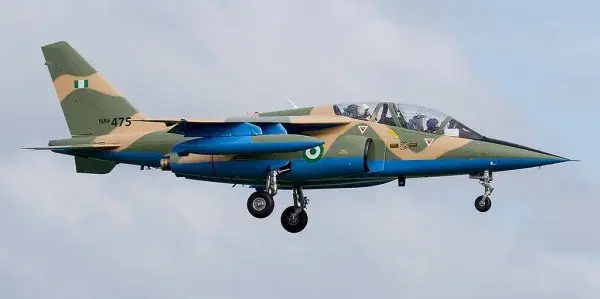
Nigeria has deployed fighter aircraft into Benin Republic’s airspace following Sunday’s attempted military coup to remove President Patrice Talon from power, multiple security sources confirmed. The move signals Abuja’s heightened vigilance as political instability unfolds in the neighbouring West African nation.
The fighter aircraft, which took off earlier in the day from Lagos, were sighted conducting aerial operations over Beninese territory as Nigeria intensified surveillance in response to the rapidly evolving security situation. According to senior security officials, the deployment is part of a broader precautionary strategy aimed at assessing regional threats and protecting Nigeria’s national interests.
The coup in Benin was reportedly led by Lt. Pascal Tigri, who announced the dissolution of state institutions and assumed full military authority. The group behind the takeover, calling itself the Military Committee for Rebuilding, declared the suspension of the November 2025 Constitution, the dissolution of all state structures, the shutdown of political activities and the closure of land, sea and air borders until further notice.
Read Also:
Benin security forces foil coup attempt against President Talon
Jonathan: Guinea-Bissau takeover was “ceremonial coup”, demands election results
The unrest in Cotonou has raised immediate alarm in Abuja. Nigeria and Benin share a long, porous border that stretches across several states, making instability in the neighbouring nation a direct security risk for Nigeria’s northwestern and southwestern regions.
France Moves to Strengthen Security Ties With Nigeria
In the wake of the coup, French President Emmanuel Macron said France would deepen its cooperation with Nigeria to confront terrorism and other security threats in the sub-region. In a message posted on Sunday, Macron expressed solidarity with President Bola Tinubu, noting that Nigeria faces “various security challenges, particularly the terrorist threat in the North.”
“At his request, we will strengthen our partnership with the authorities and our support for the affected populations,” Macron wrote. “We call on all our partners to step up their engagement. No one can remain a spectator.”
France has been expanding its defence partnership with Nigeria, including joint maritime patrols, intelligence support, training and counterterrorism collaboration.
The coup in Benin comes only days after the U.S. President Donald Trump redesignated Nigeria as a “country of particular concern,” alleging violations of religious freedoms, a move that has stirred diplomatic conversation around the region.
Analysts warn that the political crisis in Cotonou could worsen regional insecurity already fuelled by jihadist violence spreading from Mali and Burkina Faso into coastal West Africa. In April, Benin suffered one of its deadliest attacks when 54 soldiers were killed in the north by an al-Qaeda-linked group.
As Nigeria continues aerial monitoring of Benin’s security landscape, attention is focused on how quickly order can be restored and whether regional bodies such as ECOWAS and the African Union will intervene.
The situation in Benin remains fluid, with Nigeria signalling its readiness to act to preserve stability in a region already on edge.

