


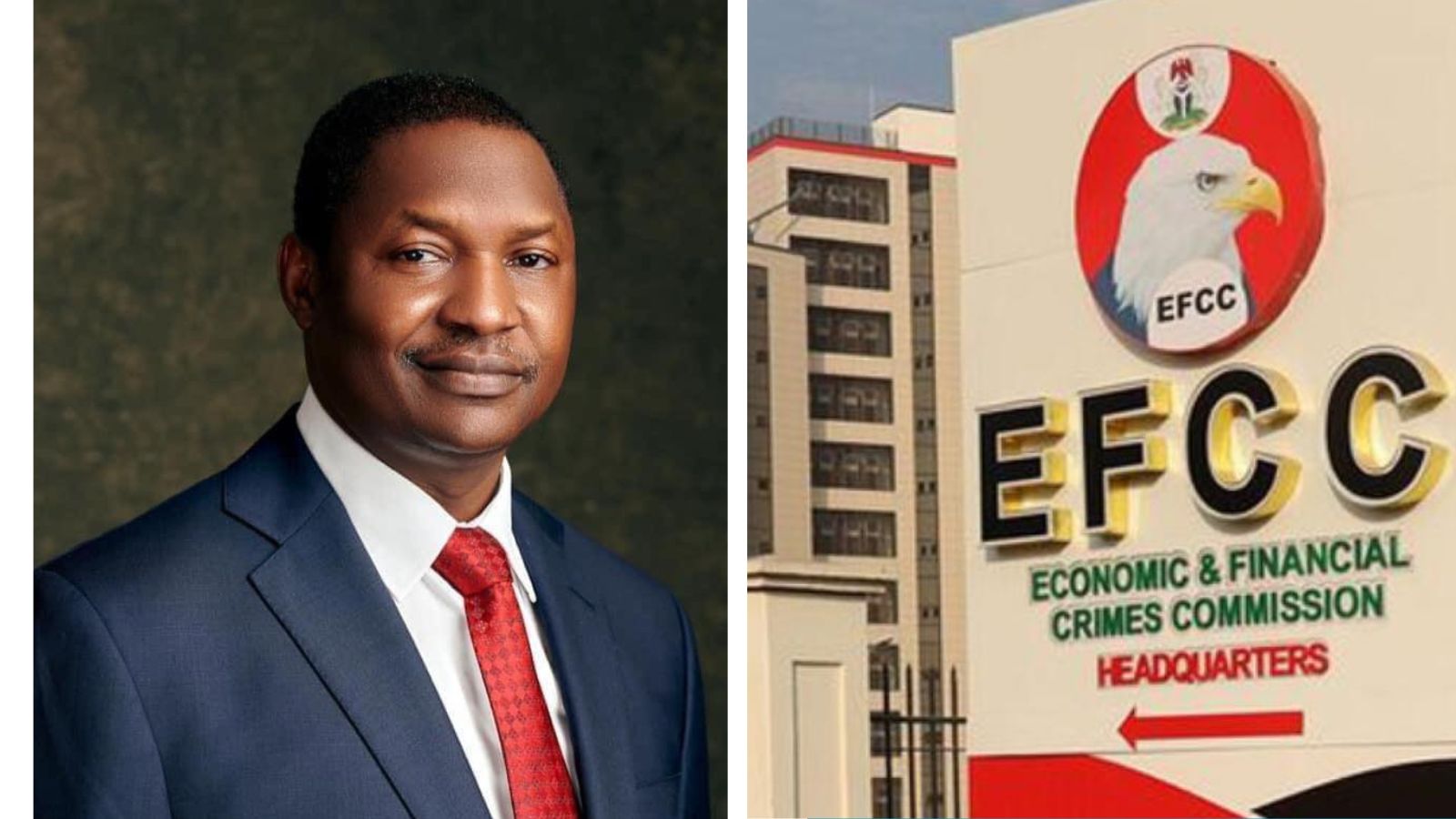
Former Nigeria’s Attorney-General and Minister of Justice, Abubakar Malami, SAN, has demanded that the chairman of the Economic and Financial Crimes Commission (EFCC) recuse himself from an ongoing investigation and threatened prosecution against him, describing the probe as politically motivated and driven by personal animosity.
In a strongly worded press statement issued on Monday, Malami said the EFCC, under its current leadership, lacked the objectivity and institutional distance required to investigate him fairly. He characterised the investigation as a “witch-hunt” rooted in political retaliation following his recent defection to the African Democratic Congress (ADC).
“The present investigation , marked by illegal detentions, media harassment and procedural abuses , bears all the hallmarks of retaliatory persecution motivated by personal vengeance,” Malami said in the statement, signed by his Special Assistant on Media, Mohammed Bello Doka.
Allegations of Conflict of Interest
Central to Malami’s argument is what he described as a long-standing conflict between himself and the EFCC chairman, which he traced back to the Justice Ayo Salami Judicial Commission of Inquiry. That commission, set up during Malami’s tenure as Attorney-General, investigated allegations of corruption and misconduct within the EFCC.
According to Malami, the outcome of that inquiry created a “historical grudge” that now undermines the credibility of the current investigation against him.
“In these circumstances, the EFCC chairman cannot reasonably be expected to act as an impartial investigator,” Malami said, adding that any continued involvement would further erode public confidence in the anti-corruption agency.
He formally requested that the EFCC chairman step aside from the matter and that the investigation be transferred to another government agency capable of conducting what he described as a neutral and transparent inquiry.
Malami also called on Nigeria’s current Attorney-General of the Federation to intervene, warning that the situation risked setting a dangerous precedent for the abuse of prosecutorial powers.
Insisting on strict adherence to constitutional safeguards, Malami said any allegations against him should be tested in open court rather than through what he termed “trial by media”.
He cited Sections 35(3), (4) and (5) of the Nigerian Constitution, which guarantee the right to personal liberty and stipulate timelines for arraignment before a competent court.
“Only a court of law — not a politically compromised agency — can lawfully adjudicate this matter,” he said.
The former minister further accused the EFCC of planning to rely on what he described as dubious witnesses, including individuals previously convicted abroad, to support its case.
He called such an approach “desperate, scandalous and corrosive to the integrity of Nigeria’s criminal justice system”, warning that it could weaken public trust in anti-corruption institutions.
Malami’s legal team, he said, has formally requested certified copies of the petitions and investigation reports forming the basis of the EFCC’s actions. These include petitions submitted by Human and Environmental Agenda and Grassroot Advocacy for Peace and Good Governance.
He maintained that his objective was not to obstruct justice but to clear his name through lawful and transparent judicial processes.
“The law must remain supreme — above politics, above power, and above persons,” he said.
Background and Political Context
Abubakar Malami, a Senior Advocate of Nigeria, served as Attorney-General of the Federation and Minister of Justice from 2015 to 2023, making him one of the longest-serving occupants of the office in Nigeria’s history.
Born on 17 April 1967 in Birnin Kebbi, Kebbi State, Malami studied law at Usmanu Danfodiyo University, Sokoto, and was called to the Nigerian Bar after attending the Nigerian Law School. He built a successful legal practice before entering national politics and was elevated to the rank of SAN in 2019, one of the highest honours in the Nigerian legal profession.
Before his ministerial appointment, Malami served as National Legal Adviser of the All Progressives Congress (APC) and played a key role in the party’s legal strategy during its rise to power.
As Attorney-General, he oversaw high-profile anti-corruption prosecutions, asset recovery efforts — including the repatriation of looted funds from foreign jurisdictions — and Nigeria’s engagement with international arbitration and legal disputes.
However, his tenure was also marked by controversy. Critics questioned some of his legal opinions and decisions, particularly on issues relating to the rule of law, executive authority and the balance of power between institutions. Supporters, on the other hand, credit him with defending government policies and strengthening asset recovery frameworks.
Since leaving office in 2023, Malami has become more active in partisan politics and has publicly declared his intention to contest the Kebbi State governorship election, positioning himself as a reform-minded candidate with extensive experience in governance.
The dispute has renewed debate over the independence of Nigeria’s anti-corruption agencies and the politicisation of law enforcement. Analysts say the case underscores longstanding concerns about selective prosecution, institutional rivalry and the fragility of public trust in accountability mechanisms.

