


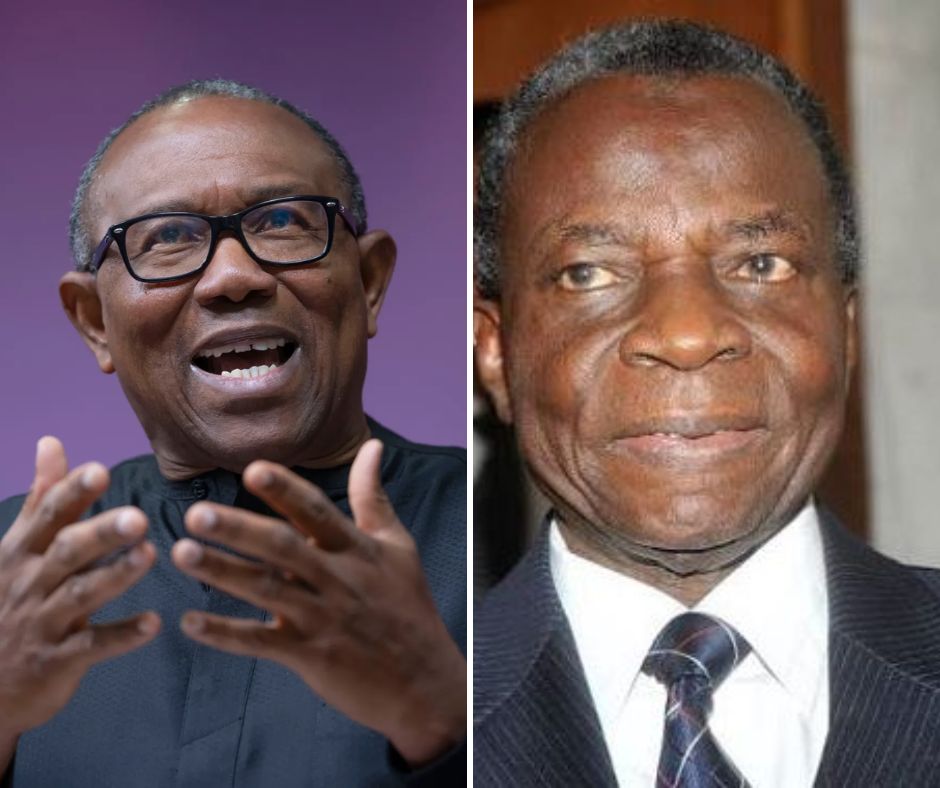
A former President of Nigeria’s Court of Appeal, Ayo Salami, has reignited controversy over the 2023 general elections, arguing that Labour Party candidate Peter Obi should not have been allowed to run.
Speaking in Ilorin on Tuesday, Salami made the remarks during a visit by the Wole Soyinka Centre for Investigative Journalism (WSCIJ), where he received an award. The delegation was led by the centre’s founder and executive director, Dapo Olorunyomi, alongside Motunrayo Alaka.
His comments have added a fresh legal dimension to ongoing discussions about the credibility of the 2023 presidential race and the processes that produced its candidates.
Read related news:
Peter Obi expresses uncertainty over ADC presidential ticket ahead of 2027 elections
Peter Obi declares intention to contest 2027 presidential election
Tinubu’s aide tackles Peter Obi over remarks on rising fuel prices
Obi’s Candidacy Questioned
Salami centred his argument on constitutional compliance, stating that key provisions were overlooked in Obi’s emergence as the Labour Party’s presidential candidate.
According to him, the timeline of events leading to Obi’s nomination raises serious legal concerns. He noted that the Labour Party had already submitted its membership register to the Independent National Electoral Commission (INEC) before Obi defected from the Peoples Democratic Party (PDP) after losing its primary election.
“For instance, Peter Obi ought not be allowed to contest the 2023 presidential election,” Salami said. “By the time he left the PDP, the Labour Party had already submitted its register. The Constitution does not recognise independent candidacy.”
His position suggests that Obi’s late entry into the Labour Party may have conflicted with electoral requirements tied to party membership and candidate nomination processes.
Salami also drew comparisons with the case involving Abba Yusuf, where questions around party membership records and candidate eligibility triggered legal disputes.
By linking the two situations, he indicated what he sees as a broader pattern of inconsistencies in how electoral rules are applied and interpreted in Nigeria.
Concerns Over Judiciary Standards
Beyond electoral matters, the retired jurist turned his attention to the state of the judiciary. He raised concerns about what he described as declining standards among some judges.
Without using strong language, Salami pointed to gaps in training and professional development, suggesting that some judicial officers may lack the depth required for complex legal decisions.
“Some of them have a problem with learning. They don’t have a good background to be judges,” he said.
He attributed part of the issue to the rapid expansion of law faculties and the pressure created by Nigeria’s growing population, which may be affecting the quality of legal education and, by extension, the bench.
Salami also criticised the process of appointing judges to higher courts, including the Supreme Court. He argued that considerations such as regional balance sometimes take precedence over merit and experience.
Reflecting on his own career, he disclosed that he had, at times, recommended junior colleagues for elevation due to zoning requirements, despite being more senior. This, he implied, illustrates structural issues within the system.
Despite his criticisms, Salami expressed gratitude to the WSCIJ for honouring him. He described the award as significant, particularly coming from an organisation known for promoting investigative journalism and accountability.
He also reflected on the influences that shaped his career, citing Nobel laureate Wole Soyinka and late nationalist leader Obafemi Awolowo. Salami said Awolowo’s historic trial played a key role in his decision to pursue a career in law.
Salami’s remarks are likely to fuel further debate among legal experts, political stakeholders and the public. His critique touches on two sensitive areas — the legality of candidate nominations and the integrity of the judiciary, both central to Nigeria’s democratic process.
As discussions continue, his intervention underscores the enduring questions surrounding the 2023 elections and the systems that govern them.

