


By Sakariyah, Ridwanullah
The Nigeria Association of Teachers of Arabic and Islamic Studies has presented a book to honour Emeritus Prof. Ismail Ayinla Babatunde Balogun.
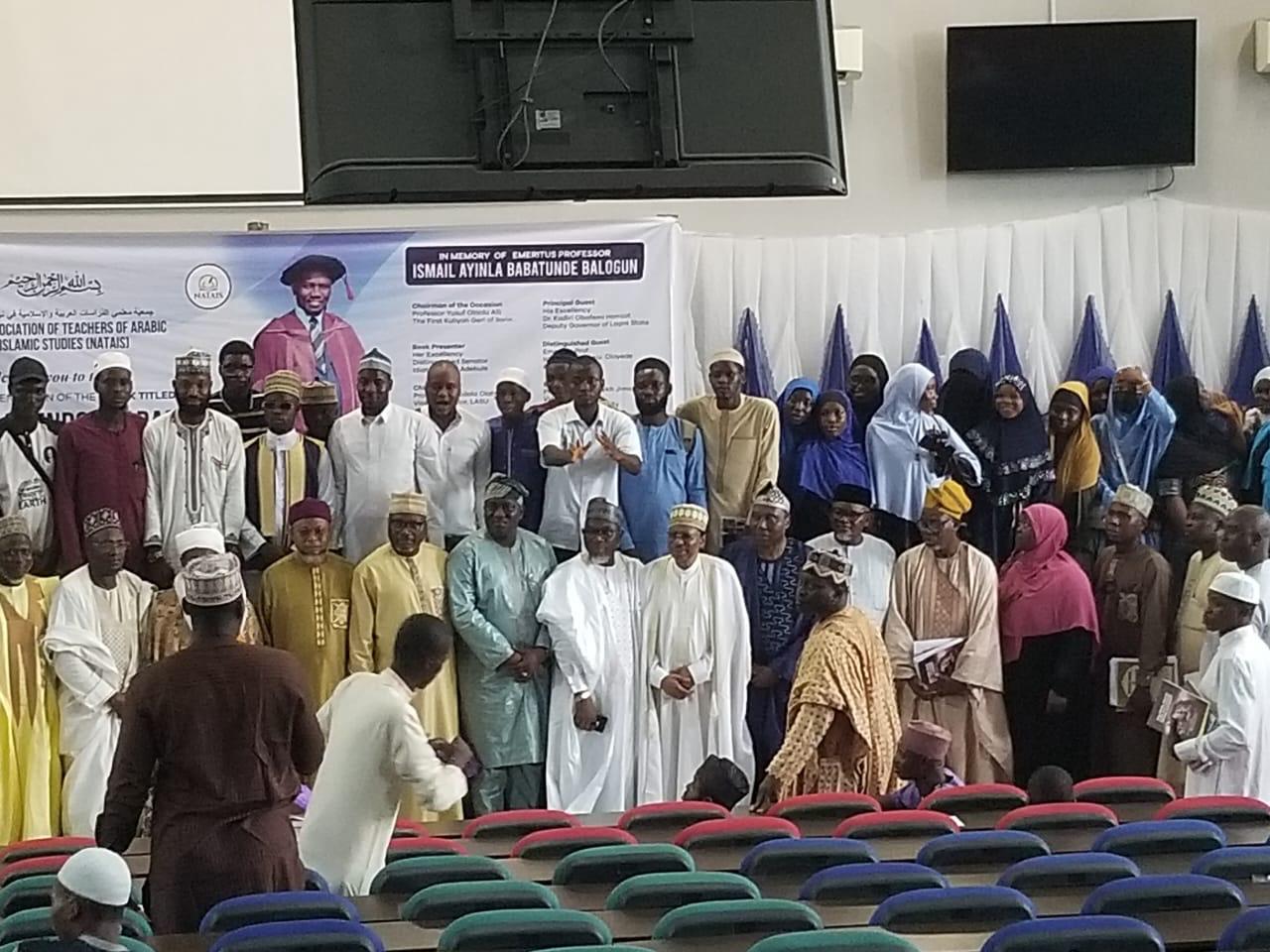
At the event attended by the New Daily Prime, a book in honour of the late academic giant, titled “Modern Trends in Arabic and Islamic Studies” was reviewed and presented on Saturday, at the Makanjuola Lecture Theatre Hall, Lagos State University, Ojo.
In his address, the NATAIS President, Prof. Musa Abdu-Raheem, described the book as “not merely an academic exercise but a roadmap for securing the future of the profession across West Africa”.
Similarly, the Lecturer of the occasion, Prof. M.O. Opeloye, emphasised the urgent need for local academics to “take ownership of the global Islamic discourse,” ensuring that the unique socio-cultural context of Nigerian Islam is accurately reflected in international scholarship and practice.
Read Also:
Nigeria flexes military power, enters Benin airspace after coup to defend its national interests
Benin security forces foil coup attempt against President Talon
Also speaking, the book reviewer, the Vice-Chancellor of Kwara State University, Prof. Lukman Shaykh Jimoh, recounted his encounters with the late professor, saying that, “For many of us, he (Emeritus Professor Ismail Ayinla Babatunde Balogun), became a model of intellectual attainment and personal integrity,” in their Arabic and Islamic education journey.
Jimoh confirmed that the volume comprised twenty-six chapters contributed by thirty-eight scholars, arranged into five well-structured sections exploring diverse topics.
He said, “These areas of modern scholarship include: inter-faith dialogue, peace keeping, Digital learning, Arabic Linguistics, Sufi traditions, Islamic jurisprudence, environmental ethics, Gender, and the Effect of technology in Islamic knowledge. According to the book reviewer, the book portrays the depth of Prof. Balogun’s intellectual legacy, and he concluded that “The book succeeds in offering a balanced and comprehensive view of contemporary Arabic and Islamic scholarship.”
Representing the Chairman of the occasion, the First Kuliya Geri of Ilorin, Prof. Yusuf Olaolu Alli, the Vice-Chancellor of Al-Hikmah University, Prof. AbduLlateef Oladimeji Folorunsho, gave a personal testimony regarding the late professor, whom he personally drove for many years.
Folorunsho recounted how Balogun added immense significance to his life, highlighting how kind, generous, and benevolent Prof. Balogun was to him and others.
He specifically noted how much Prof. Balogun dedicated his life to the academic and spiritual growth of other children who now became great personalities.
The Prof. noted, “The single most important lesson he learnt from the late academic was the absolute need for “Truth,” no matter what the situation is, urging the audience to uphold that ethical standard. Beyond this personal tribute, he affirmed that the legacy of Professor Balogun mandates a continuous push for excellence in scholarship, adding that “the torch of inquiry lit by the late professor must be guarded fiercely against obsolescence.”
The formal presentation and launch of the book were then performed by the Lagos NATAIS Chairman Prof. Paramole Kabir Olawale, who represented the officially designated presenter, Senator Idiat Oluranti Adebule.
Also, the Commissioner of Home Affairs, Ibrahim Olayode represented the Deputy Governor of Lagos state, Dr Kadiri Obafemi Hamzat, and delivered the official goodwill message.
Speaking on behalf of the state government, Olayode emphasised that the principles championed by Islamic education are essential for tackling societal decay.
He said, “The Deputy Governor of Lagos state recognises that the foundation of a stable and prosperous society lies in ethical instruction.”
Additionally, Dr. Adebisi, representing the Vice-Chancellor of the University of Ilorin, Prof. Wahab, delivered a keynote speech. Dr. Adebisi opened by happily referring to Prof. Balogun as his “Baba,” stating that 95 per cent of his mentors were mentees of Prof. Ismail Ayinla Babatunde Balogun.
He described him as “a professor of inter-faith and intercultural dialogue, for peaceful coexistence of Nigerians and beyond.”
The event concluded after the final address, marking the formal tribute to Prof. Balogun’s lasting impact on the Arabic and Islamic educational landscape in Nigeria.

