


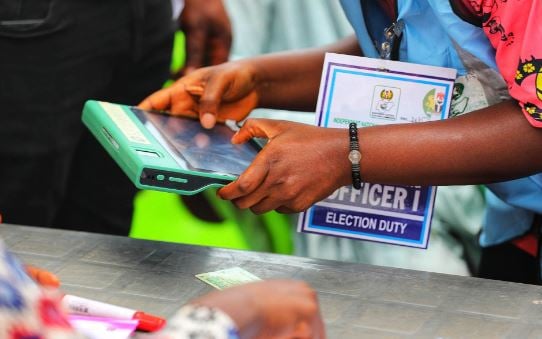
The Independent National Electoral Commission (INEC) on Saturday carried out a mock accreditation and voting exercise across the Federal Capital Territory as part of its build-up to the FCT Area Council elections scheduled for February 21, 2026.
Speaking during a “train-the-trainers” session for Supervisory Presiding Officers (SPOs), INEC Chairman, Prof. Joash Amupitan (SAN), said the exercise was aimed at assessing the commission’s preparedness while strengthening the capacity of election officials ahead of the polls.
Amupitan urged the trainees to approach the exercise with seriousness and to thoroughly study the election manual developed by the commission to guide their work.
“What is happening here is very interactive. It is not just about what you are taught, but about your understanding of what is being taught. Your instructors are guiding you based on a manual we have prepared to ensure uniformity across the area councils,” he said.
He reminded the SPOs of the importance of their role in the electoral process, warning against compromise and stressing the country’s need for credible elections.
“In less than two weeks, the election will be happening, and you have a key role to play. You are being trained so that you will train others. Please, do not compromise. Nigeria is in dire need of a very stable electoral process,” Amupitan said.
According to him, INEC is determined to rebuild public trust in elections through adequate training, simulations and on-the-ground testing.
“That is why, apart from this training, we are also conducting a mock accreditation and voting exercise, so that we are sure everything is in place ahead of the FCT Area Council election of February 21, 2026,” he added.
Describing the SPOs as “key actors” in elections, the INEC chairman noted that while senior officials may operate from offices, it is the field staff who ultimately determine how smoothly elections are conducted.
“You are the people on the ground. Whatever happens in the field reflects on the commission. Please, let us not disappoint the nation,” he said.
Amupitan also acknowledged the sacrifices of election officials, particularly given the modest allowances, and appealed to them to see their participation as a service to the nation.
“Take this as your contribution to nation-building. I hope that one day, efforts like this will be recognised and rewarded at the highest levels,” he said.
During a separate interaction with journalists while inspecting the mock exercise, Amupitan said he was pleased with the performance of the Bimodal Voter Accreditation System (BVAS), describing the test as crucial to INEC’s operational readiness.
“This is basically to test our preparedness ahead of the election. Our major focus is the functionality of the BVAS, which for us is a game changer. We have improved on it and we do not want to use the main election as a guinea pig,” he said.
He explained that the simulation allowed the commission to test both the device and recent upgrades under near-real election conditions.
“So far, I am very satisfied that the BVAS has worked excellently well. At this polling unit, about 11 voters have been accredited and have voted. We even tried to simulate a real scenario by asking someone who had already voted to come back, and the BVAS immediately flagged that the person had already been accredited,” Amupitan said.
He noted that the system effectively prevents multiple accreditation and voting.
“With this technology, there is no way you can be accredited twice. There is no way you can vote twice. After voting, the results sheet is signed as in a normal election, and party agents are present to observe the process,” he added.
Although civil society observers were expected, Amupitan said the exercise still provided valuable insights.
“From what I have seen, it is a very worthy exercise. We are also using this to create awareness and mobilise voters to come out and vote on February 21,” he said.
On overall readiness, the INEC chairman said non-sensitive materials had been fully deployed, training was progressing, and presiding officers would be trained in the coming week, adding that all systems tested so far were functioning properly.
While acknowledging longstanding concerns about voter apathy, he expressed confidence that turnout would improve.
“Voter apathy has been with us for several years, but I am sure this one will be much better. We are using every means to pass the message across that the election will take place on February 21, 2026,” he said.
Addressing concerns about network challenges in rural and satellite areas, Amupitan said contingency measures had been put in place.
“We have worked on the necessary operational protocols. Presiding officers can use hotspots where necessary, and even if there is no internet at a particular spot, once the device moves to an area with connectivity, the system will upload the results automatically,” he explained.
On electronic transmission of results and public confidence, he said the matter remains under consideration by the National Assembly.
“The law-making process is ongoing. There will be harmonisation between the two chambers. Let us not create unnecessary tension,” Amupitan said.
Read more news on www.newdailyprime.news

