


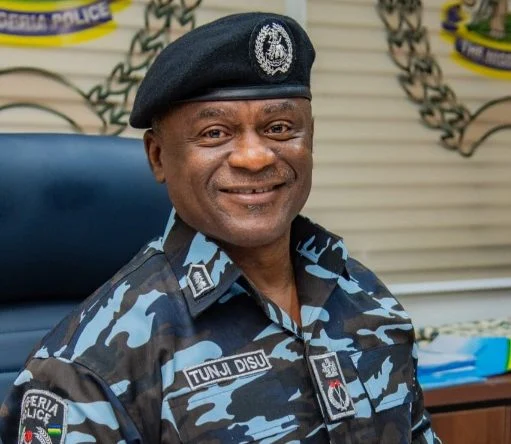
The Inspector-General of Police (IGP), Tunji Disu, on Wednesday inaugurated an eight-member committee to oversee the implementation of state police and advance his broader policing vision, marking his first formal engagement with senior police officers since his confirmation as the 23rd indigenous IGP.
The inauguration comes days after the Nigeria Police Council unanimously ratified Disu’s appointment, paving the way for his formal swearing-in by President Bola Tinubu at the Presidential Villa in Abuja. Professor Olu Ogunsakin was appointed to lead the newly formed committee, which will coordinate efforts to decentralise policing and strengthen internal oversight across the Nigeria Police Force.
Addressing the top hierarchy of the force, Disu emphasised that leadership “is not about position but responsibility,” highlighting that professionalism, accountability, and respect for human rights must guide conduct and operations nationwide. “Authority is strongest when exercised with restraint. Every Nigerian must be treated with dignity, fairness, and justice, regardless of status or background,” he said.
Disu also outlined plans to empower internal oversight bodies, including the Public Complaint Unit and X-Squad, to operate independently, ensuring that complaints against officers are addressed promptly and transparently. He stated that decentralisation would enable different levels of government to play a more active role in local security matters, part of a broader strategy to enhance responsiveness and reduce crime rates.
The inauguration of the state police implementation committee coincides with a period of heightened security challenges in Nigeria, including rising cases of kidnappings, banditry, and violent community attacks. Analysts have noted that the initiative forms a central component of ongoing security sector reforms championed by the current administration, aimed at strengthening local policing capacity while ensuring accountability at all levels.
President Tinubu had appointed Disu as Acting IGP on 24 February 2026, following the resignation of his predecessor, Kayode Egbetokun. Disu’s elevation was endorsed by the Nigeria Police Council and is expected to be formalised during a Federal Executive Council meeting.
Speaking on the future of policing, Disu stressed that the reforms would prioritise community engagement and operational efficiency. “Policing is a public service, not merely a command. We must build trust with communities and ensure that security is delivered fairly and effectively,” he said.
With the establishment of the eight-member committee, the Nigeria Police Force signals a new era of reform under Disu’s leadership, one that seeks to combine decentralisation, human rights observance, and strengthened internal oversight to address longstanding security challenges across the country.

