


Former senior officials of the Independent National Electoral Commission (INEC) have raised concerns that conflicting provisions on electronic transmission of results in the Electoral Act 2026 could undermine electoral integrity if not urgently clarified.
The warning was issued on Friday in Abuja during a roundtable organised by Yiaga Africa. The event, themed “Electronic Transmission and Electoral Integrity: Safeguarding the Vote under the Electoral Act 2026,” brought together electoral experts and civil society leaders to examine the implications of the new law.
President Bola Ahmed Tinubu recently signed the amended Electoral Act 2026 into law, prompting INEC to adjust the election timetable following the repeal of the 2022 Act.
Among those who spoke at the event were former INEC National Commissioner Festus Okoye, former Resident Electoral Commissioner Mike Igini, and former ICT Director, Engr. Chidi Nwafor.
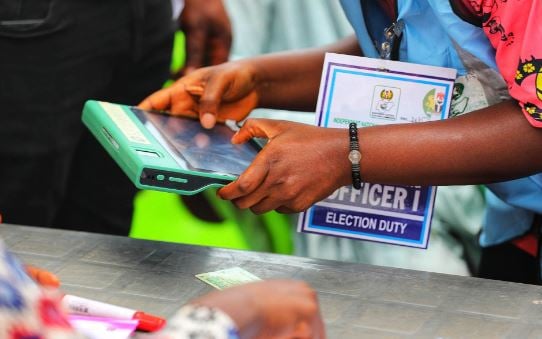
Okoye, who previously chaired INEC’s Information and Voter Education Committee, noted that while the Bimodal Voter Accreditation System (BVAS) remains an innovative tool, the 2026 Act contains drafting inconsistencies that could create confusion in implementation.
He explained that although the National Assembly replaced references to the Smart Card Reader with BVAS in certain sections of the law, it failed to do so uniformly across the legislation. As a result, both technologies are still mentioned in different parts of the Act.
“Where BVAS appears in the principal section, Smart Card Reader is still retained in other parts of the Act. The National Assembly needs to clean up the drafting to avoid ambiguity,” Okoye said.
He cautioned against embedding specific technological devices in legislation, arguing that electoral bodies should retain discretion to adopt evolving technologies without requiring constant amendments to the law.
A key area of concern is Section 60 of the Act, which mandates electronic transmission of polling unit results to INEC’s Result Viewing Portal (IReV) but also states that the manually completed Form EC8A remains the primary basis for collation and declaration.
Okoye pointed out that Sections 60 and 65 appear to envisage two forms of transmission — one for public viewing and another for collation — while Section 155 defines “transmit” as either manual or electronic. He argued that, strategically interpreted, electronically transmitted results to the collation system should carry greater evidentiary weight in cases of discrepancy.
Former ICT Director Nwafor traced Nigeria’s electoral technological reforms to early digitised voter registration efforts in 2003 and the introduction of biometric accreditation under former INEC Chairman Attahiru Jega.
The former officials urged lawmakers to urgently harmonise the provisions of the Act to eliminate ambiguities and safeguard the credibility of future elections.

