


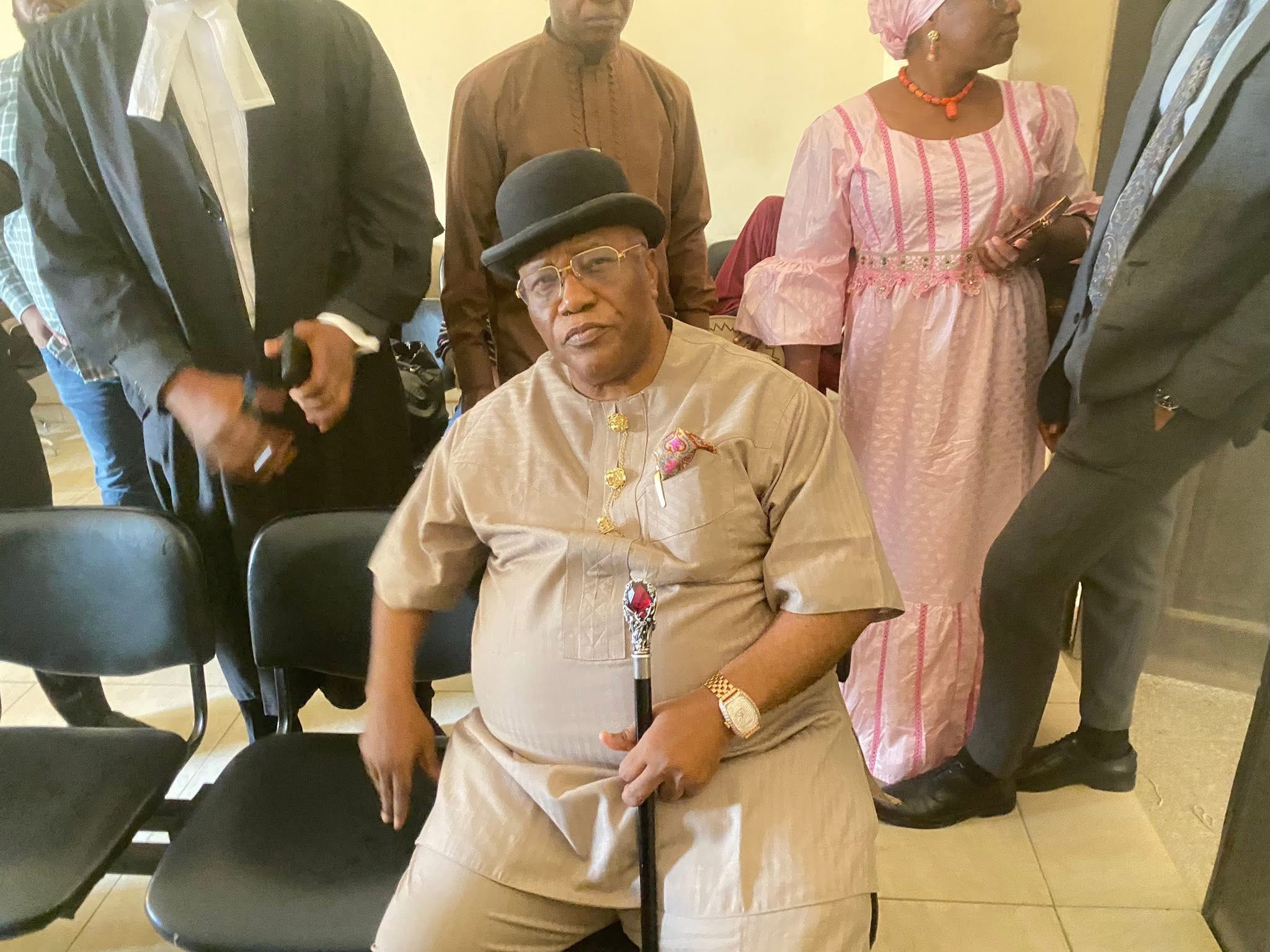
The Economic and Financial Crimes Commission (EFCC) on Thursday, January 29, 2026, arraigned BFI Group Corporation and six others before the Federal Capital Territory (FCT) High Court, Jabi, Abuja, over an alleged €100 million fraud.
Those charged alongside the company are Reuben M. Jaja, Uzor Chidi Jerry, David Femi James, Imeobong Jumbo Udom, Adeola Edward and Emeka Emmanuel Okorie.
READ MORE:NEITI deepens alliance with EFCC, ICPC to strengthen accountability in extractive sector
EFCC arraigns businessman, firm in Lagos over alleged $550,000 fraud
They were arraigned before Justice M.S. Idris on a five-count amended charge bordering on conspiracy, fraud and obtaining by false pretence.
At the proceedings, prosecuting counsel, Ekele Iheanacho, SAN, informed the court of an amended charge dated January 27, 2026, and filed the same day, urging the court to have the charge read to the defendants to enable them enter their pleas.
One of the counts alleged that the defendants, between August 12, 2020 and March 2021, conspired to induce the Central Bank of Nigeria (CBN) to confer financial benefit on BFI Group Corporation through false pretence.
According to the charge, the defendants “with intent to defraud, conspired amongst yourselves to induce the Central Bank of Nigeria to confer benefit on BFI Group Corporation by false pretence,” an offence said to be contrary to Sections 8(a) and 1(3) of the Advance Fee Fraud and Other Related Offences Act.
Another count alleged that BFI Group Corporation and Reuben M. Jaja attempted to fraudulently obtain a Certificate of Capital Importation (CCI) for €100 million by falsely claiming that the sum had been paid into a non-existent CBN account.
The charge stated that the defendants “did attempt to obtain Certificate of Capital Importation for the sum of €100,000,000 in favour of BFI Group Corporation by falsely claiming that the said amount was paid into an account maintained by the Central Bank of Nigeria, when you knew that no such account number existed.”
The defendants pleaded “not guilty” to all the charges when they were read to them.
Following their pleas, Iheanacho requested a trial date and sought time to respond to the bail applications filed by the defence and served on him in court.
However, counsel to the first and second defendants, Chinedu Eze, made an oral bail application, urging the court to admit the defendants to bail pending trial. He cited provisions of the Administration of Criminal Justice Act (ACJA), 2015, and the case of Abiola v. FRN (1995), further asking the court to grant the second defendant bail on self-recognition.
The prosecution opposed the application, arguing that the authorities relied upon by the defence were inapplicable.
“My lord, a suspect who has been charged is no longer a suspect but a defendant, and Section 162 of the ACJA regulates bail in a criminal trial like this,” Iheanacho said.
He added, “The reference to Abiola v. FRN (1995) does not apply, as it was decided before the advent of the ACJA which now guides this court. The defendants have already applied for bail in writing, and those applications are pending. To now turn around and seek oral bail is inconsistent and misplaced.”
Iheanacho urged the court to discountenance the oral application in the interest of fair hearing.
Justice Idris adjourned the matter to February 3, 2026, for ruling and adoption of bail applications.
The court also ordered that the fourth defendant be remanded in the EFCC holding facility, while the other defendants were remanded at the Kuje Correctional Centre pending further proceedings.

