


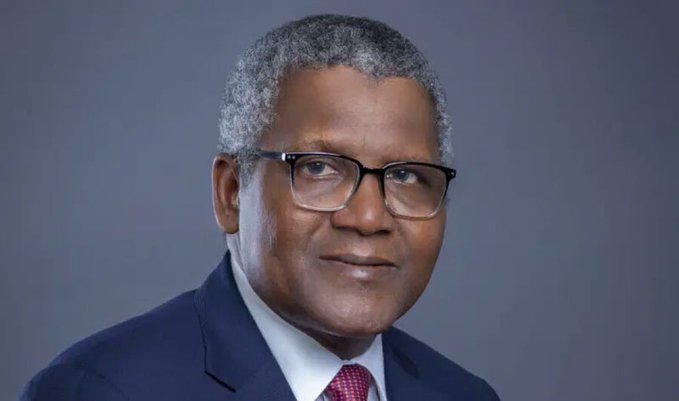
Africa’s richest man, Aliko Dangote, has donated a quarter of his personal wealth to the foundation – Aliko Dangote Foundation, marking one of the most significant philanthropic pledges in the continent’s history. He made the announcement in Lagos on Thursday during the unveiling of the foundation’s new education initiative, a programme he described as a long-term investment in Africa’s future.
Dangote explained that his mother and three children had already signed off on the arrangement, making the pledge binding even in the event of his death. As part of the new initiative, he also announced a ₦100 billion investment beginning in 2026 to support more than 155,000 learners across Nigeria. In addition, he committed ₦590 million annually to sustain a school for orphaned girls in Maiduguri for as long as the institution continues to operate.
This latest step deepens Dangote’s long-standing commitment to philanthropy, which has been shaped by a career that transformed him into one of the world’s most influential industrialists. Born in Kano on April 10, 1957, into a prominent merchant family, Dangote developed an early interest in business, inspired by his grandfather, Sanusi Dantata. After studying business in Cairo, he returned to Nigeria to begin what would eventually become the continent’s largest manufacturing empire.
Read Also:
Dangote assures Nigerians fuel prices will remain stable despite 15% import tariff
CBN releases $1.26bn for fuel imports despite Dangote Refinery output
Dangote Refinery assures Nigerians of uninterrupted fuel supply during festive season
His journey began in 1977 when he set up a small trading firm in Lagos with a loan from his uncle. Although the business initially focused on importing commodities, Dangote soon shifted toward local production, believing that Nigeria’s long-term economic strength required domestic manufacturing rather than dependence on imports. This philosophy laid the foundation for the Dangote Group’s expansion into sugar refining, flour milling, pasta production and, eventually, cement manufacturing.
The establishment of Dangote Cement dramatically altered Nigeria’s industrial landscape. By investing heavily in domestic plants and expanding into several African countries, Dangote reduced Nigeria’s reliance on imported cement and cemented his position as a major force in the continent’s building materials sector.
One of his most ambitious undertakings, the multi-billion-dollar Dangote Refinery in Lagos, is expected to rewrite the narrative of Nigeria’s oil industry. Designed to end the country’s dependence on imported fuel and reposition Nigeria as a major exporter of refined petroleum products, the refinery represents a milestone in Dangote’s vision of African self-sufficiency. Similar ambition guided the development of the Dangote Fertiliser Plant, which has become a crucial supplier to both African and international agricultural markets.
Much of Dangote’s success has been attributed to his disciplined, long-term approach to business. He has consistently argued that industrialisation is the most powerful tool for lifting millions out of poverty and that Africa must invest in adding value rather than exporting raw materials. His business philosophy is built on patience, scale and a belief in regional economic integration.
Beyond business, Dangote has become a major player in humanitarian work. His foundation has funded major health programmes, including polio eradication campaigns and nutrition initiatives, and has supported disaster response efforts and educational programmes. The latest pledge, which includes the commitment to sustain the Maiduguri girls’ school indefinitely, signals a deepening of that mission.
Despite his global recognition and enormous economic influence, Dangote has not been without critics. Some argue that his rise was helped by favourable government policies and market protections, while others raise concerns about the dominance of his companies in certain sectors. Supporters, however, maintain that such policies were necessary to build industries capable of supporting national development, and often note that many African countries still struggle because similar investments were never made.
Yet Dangote’s legacy increasingly appears to be defined not only by the industries he has built but by the lives he seeks to transform. As he told the audience in Lagos, education remains one of the most powerful tools for social progress, and no nation can prosper if its children lack opportunity. His pledge, he said, reflects a belief that wealth must serve a purpose beyond personal success.
With his donation of a quarter of his fortune and the rollout of the ₦100 billion education initiative, Dangote has positioned himself not only as a titan of African industry but as one of its most consequential philanthropists. His influence now extends from factories and boardrooms to classrooms and communities, shaping not just Nigeria’s economy but the hopes and possibilities of its next generation.

