


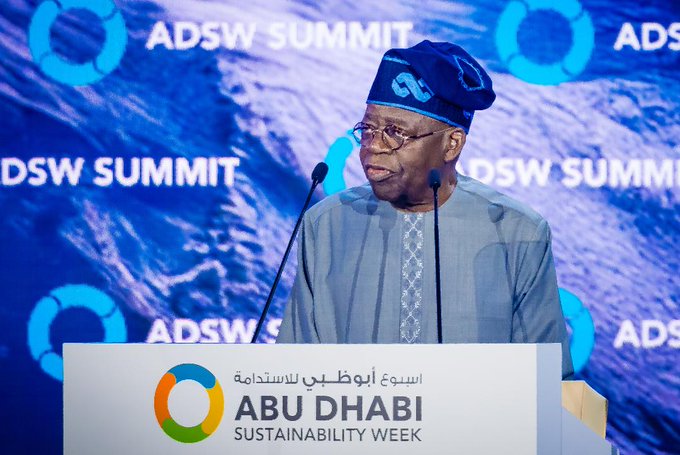
President Bola Tinubu and UAE President Mohamed bin Zayed Al Nahyan have signed a Comprehensive Economic Partnership Agreement (CEPA), a landmark trade deal designed to eliminate barriers and unlock billions in sustainable investments.
Speaking on Tuesday at the Abu Dhabi Sustainability Week (ADSW), Tinubu also announced that Nigeria will co-host the prestigious global investment forum, Investopia, in Lagos this February.
The event will serve as a physical marketplace to convert these high-level diplomatic ideas into high-impact capital for Nigeria and Africa.
READ ALSO: Obi questions Tinubu’s absence, warns of leadership vacuum amid national crisis
The new agreement (CEPA) is one of Nigeria’s most ambitious trade pacts, focusing on renewable energy, digital trade, aviation, and climate-smart infrastructure.
The agreement prioritises tariff elimination through the immediate and phased removal of duties on more than 7,000 products traded between both countries.
It also expands market access by opening opportunities for Nigerian manufacturers and professionals across 108 service sectors in the Middle East.
Additionally, it provides investor clarity by establishing a clear legal and fiscal framework designed to give UAE investors greater confidence to support Nigeria’s productive economy.
Addressing world leaders, Tinubu issued a bold challenge to the global financial community: Nigeria aims to mobilize up to $30 billion annually in climate and green industrial finance.
“The foundation of every modern economy is electricity,” Tinubu stated. “We are calling for a fundamental shift in the global financial architecture—a move away from restrictive sovereign guarantees that unfairly penalise developing economies.”
Nigeria’s green strategy includes the use of blended finance, with the deployment of first-loss capital to attract private sustainable investment into projects without adding pressure to the national debt.
It also involves activating the carbon market through the recently adopted National Carbon Market Activation Policy and the establishment of a National Carbon Registry, a move expected to attract up to $3 billion in annual carbon credit revenue.
Also, the strategy leverages the Electricity Act 2023 to expand decentralised power, aiming to deliver clean energy to 17.5 million people through a $750 million World Bank-backed programme.
The President revealed that ongoing fiscal and monetary reforms were already delivering measurable results, including a 21 per cent increase in non-oil exports and more than $50 billion in total investment commitments secured across key sectors.
He also reaffirmed the country’s 2060 net-zero target, stressing the government’s commitment to an energy transition while prioritising local processing of critical minerals such as lithium.
READ ALSO: ADC criticises South-East APC’s endorsement of Tinubu for 2027 re-election
Tinubu invited the global community to Lagos in February for Investopia, promising that the summit would “build the next chapter of shared prosperity.”
The forum is expected to bring together policymakers, tech unicorns, and global fund managers to finalise the next wave of investments into Nigeria’s energy, tech, and agricultural sectors.
For more details, visit New Daily Prime at www.newdailyprime.news.

