


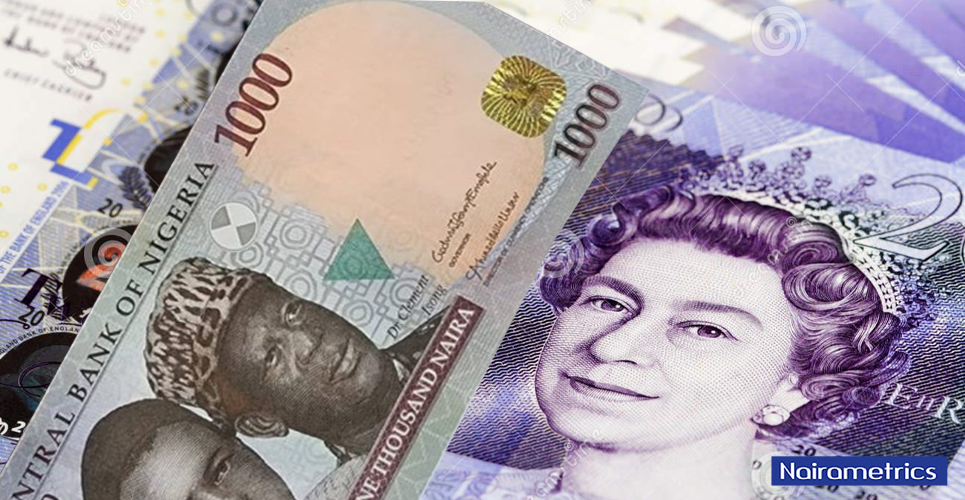
The Nigerian naira strengthened noticeably against the British pound on 7 January, posting gains at both the official and parallel segments of the foreign exchange market.
Data obtained from the NGNToday platform showed that the pound exchanged at N1,920 at the official market and N2,000 at the black market, marking a significant improvement from the weaker levels recorded a day earlier.
On 6 January, the naira had traded at N1,936 to the pound at the official window and M2,150 at the parallel market.
The movement recorded on Wednesday therefore reflects a clear appreciation of the local currency, reversing the depreciation trend seen in the previous session.
At the official foreign exchange market, the naira’s gain against the pound was attributed to relative stability in trading conditions and moderated demand pressure.
Market analysts noted that while the pound remains one of the most sought-after foreign currencies in Nigeria due to trade, travel and education-related transactions, demand appeared more balanced during Wednesday’s session.
This allowed the naira to recover to N1,920, offering some relief to businesses and individuals with pound-denominated obligations.
The improvement was also evident at the parallel market, where the pound traded at N2,000, a sharp drop from the N2,150 recorded the previous day.
The size of this movement suggests easing pressure in the informal market, where rates are typically more volatile and highly sensitive to shifts in demand and supply. Observers said the reduction in the black market rate points to improved availability of foreign currency and cautious buying by market participants.
Despite the gains recorded on Wednesday, analysts cautioned that the broader foreign exchange environment remains fragile.
The pound-to-naira exchange rate has experienced wide fluctuations in recent weeks, reflecting both domestic economic challenges and external factors such as movements in the global foreign exchange market.
As a result, short-term improvements, while encouraging, may not necessarily signal a sustained trend without consistent policy support and increased foreign exchange inflows.
Businesses that rely on pound-denominated imports welcomed the naira’s appreciation, noting that lower exchange rates could help reduce input costs and ease pricing pressures.
Educational institutions, travel agencies and individuals paying school fees or medical bills abroad also stand to benefit from the improved rates, particularly at the parallel market where many transactions are conducted.
However, some market participants remain cautious, pointing out that demand for the pound often rises sharply during peak travel and academic periods. If demand increases without a corresponding rise in supply, the naira could once again come under pressure. This highlights the ongoing challenge of achieving stability across both the official and informal segments of the forex market.
Economic analysts stressed that sustained improvements in the naira’s performance against major currencies like the pound will depend largely on structural reforms and stronger dollar and pound inflows.
Increased export earnings, higher oil revenues, improved diaspora remittances and renewed investor confidence are seen as key factors that could support the local currency over the medium term.
In addition, continued efforts to enhance transparency and efficiency in the foreign exchange market are expected to play a critical role in narrowing the gap between official and black market rates.
A more unified and predictable exchange rate environment, analysts say, would reduce uncertainty for businesses and support broader economic growth.
For More Details, Visit New Daily Prime at www.newdailyprime.news

