


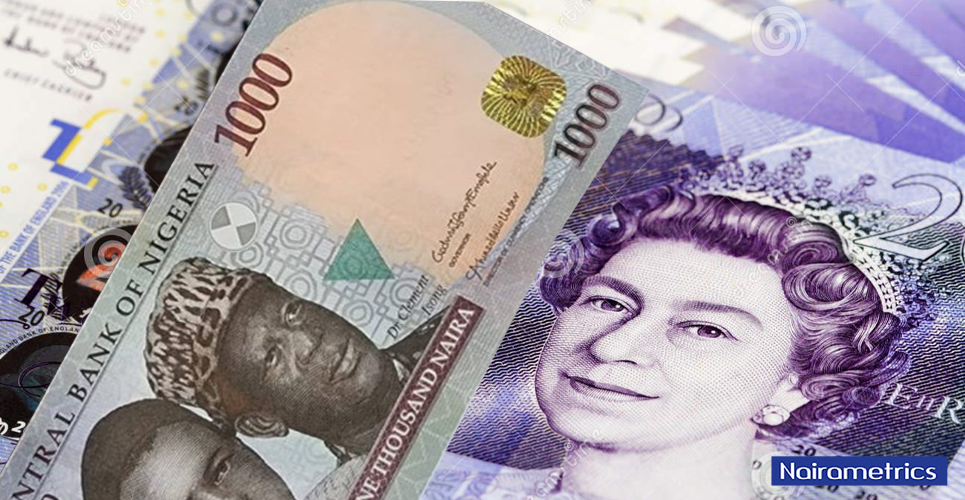
The Nigerian foreign exchange market presented another tale of divergence on 8 January, as the British pound sterling displayed contrasting movements across official and parallel trading windows.
Fresh figures published by the NGNToday platform indicate that while the pound weakened slightly at the official market, pricing in the black market remained unchanged, reinforcing the cautious and segmented nature of Nigeria’s FX environment.
At the official foreign exchange window, the British pound was exchanged at N1,917, reflecting a depreciation when compared with the N1,920 recorded on 7 January. Though marginal, the decline highlights a continued adjustment process within the regulated market, where exchange rates are increasingly influenced by liquidity management, selective FX supply, and demand moderation.
Analysts describe the movement as part of a broader recalibration rather than a sharp reversal, noting that official rates often respond gradually to changing market conditions.
In contrast, the black market maintained a steady position, with the pound trading at N2,000, unchanged from the previous day. According to NGNToday data, the lack of movement in the parallel market suggests that traders and buyers are adopting a wait-and-see approach, holding prices firm amid uncertainty over near-term FX supply. Despite the official depreciation, the parallel market showed little incentive to adjust, reflecting its sensitivity to demand pressure rather than policy signals.
The stability of the black market rate, even as the official rate softened, underscores the persistent disconnect between the two segments. While the official market continues to reflect policy-guided pricing and controlled access, the parallel market remains largely driven by unmet demand from businesses and individuals unable to source foreign exchange through formal channels.
This structural imbalance continues to sustain a wide spread between official and unofficial rates.
Currency dealers note that the slight depreciation of the pound at the official window may be linked to reduced institutional demand or short-term liquidity improvements. In some cases, targeted FX allocations or lower demand from importers can temporarily strengthen the naira against major currencies.
However, such gains often remain confined to the official segment unless backed by sustained inflows and broader market confidence.
For the black market, the unchanged rate points to entrenched expectations. Traders appear reluctant to reprice downward in the absence of clear signals that FX availability has improved meaningfully. As a result, the pound continues to trade at a premium of over ₦80 compared with the official rate, highlighting the cost burden faced by users of the informal market.
Economists warn that persistent gaps between official and black market rates carry wider implications for the economy. Higher parallel market rates feed into import costs, inflationary pressures, and overall price instability. Businesses that depend on black market FX often pass these higher costs on to consumers, further straining household purchasing power.
Despite ongoing reforms aimed at improving transparency and unifying the FX market, progress remains uneven. Analysts argue that lasting stability will depend on stronger export earnings, increased foreign capital inflows, and consistent policy execution. Without these fundamentals, daily movements are likely to remain modest and fragmented across market segments.
Meanwhile, for businesses, investors, and individuals tracking the pound–naira exchange rate, Thursday’s figures reinforce the importance of monitoring both official and parallel markets. Even small shifts at the official level can influence expectations, while apparent stability in the black market can quickly give way to volatility if demand spikes or supply tightens.
For More Details, Visit New Daily Prime at www.newdailyprime.news

