


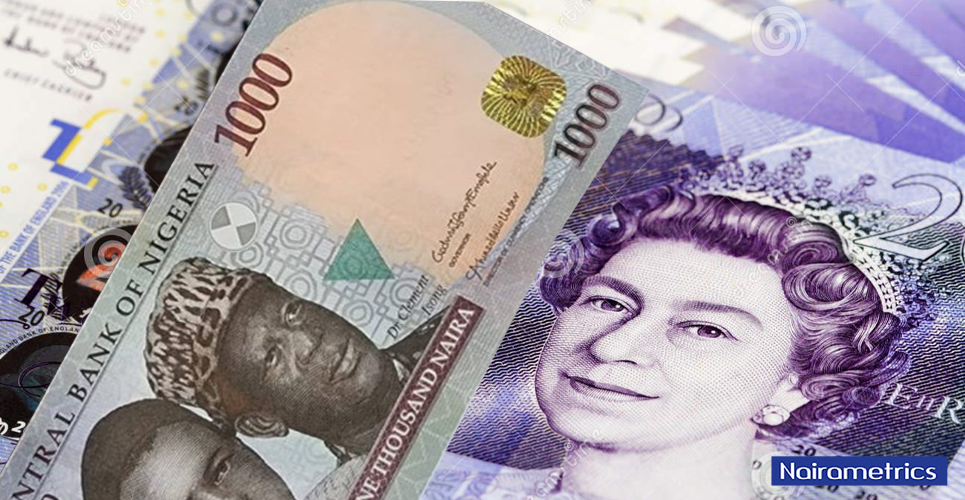
Foreign exchange data from the NGNToday platform indicates a modest but notable depreciation of the British pound against the Nigerian naira on 9 January, with declines recorded in both the official and parallel market segments.
According to the latest figures, the official exchange rate for the pound closed at N1,914, while the black market rate settled at N1,970. This represents a downward movement from the previous trading day, when the pound exchanged at N1,917 officially and N2,000 in the parallel market.
From a data-driven perspective, today’s figures point to a short-term correction rather than a sharp reversal in trend. The N3 decline at the official market and the more pronounced N30 drop in the black market suggests easing demand pressures for the pound, particularly among retail buyers and informal market participants.
Such movements often reflect changing transaction patterns rather than structural shifts, especially when depreciation is uneven across market segments.
At the official level, the marginal dip to ₦1,914 indicates a largely stable institutional market. Official rates are typically influenced by regulated demand from importers, service payments, tuition fees, and other documented transactions.
The slight depreciation suggests that pound inflows and outflows remain broadly balanced, with no significant disruption to supply. This stability highlights the buffering role of policy controls and structured access within the official foreign exchange framework.
In contrast, the parallel market displayed a stronger adjustment. The pound’s drop from N2,000 to N1,970 represents a recalibration driven by softer demand and reduced speculative activity.
The black market is particularly sensitive to short-term sentiment, and today’s decline implies that buyers were less aggressive, possibly due to improved dollar and pound availability or a temporary slowdown in overseas payment needs.
A key analytical insight emerges from the spread between the official and black market rates, which now stands at N56. While this gap remains significant, it has narrowed slightly compared to the previous day, when the difference exceeded N80.
A shrinking spread often signals improved alignment between formal and informal markets, suggesting that pricing expectations are converging. This can occur when traders adjust to reduced arbitrage opportunities or when demand in the parallel market cools.
Trend analysis also points to behavioural factors influencing today’s outcome. With no major policy announcements or external shocks, market participants appear to be responding to near-term liquidity conditions rather than long-term forecasts.
The sharper adjustment in the black market indicates that price discovery is ongoing, with traders responding quickly to changes in buyer interest.
For businesses and individuals with pound-denominated exposure, today’s data offer mixed signals. On one hand, the depreciation reduces the naira cost of pound-related transactions, such as school fees and professional services.
On the other hand, the persistence of a wide market spread underscores ongoing inefficiencies in the forex market, which continue to complicate planning and pricing decisions.
It is also important to place today’s movement within a broader macroeconomic context. Exchange rate performance remains closely tied to external reserves, capital inflows, trade balances, and global currency trends.
Any changes in these fundamentals could quickly alter the pound’s trajectory against the naira, particularly in the more reactive parallel market.
For More Details, Visit New Daily Prime at www.newdailyprime.news

