


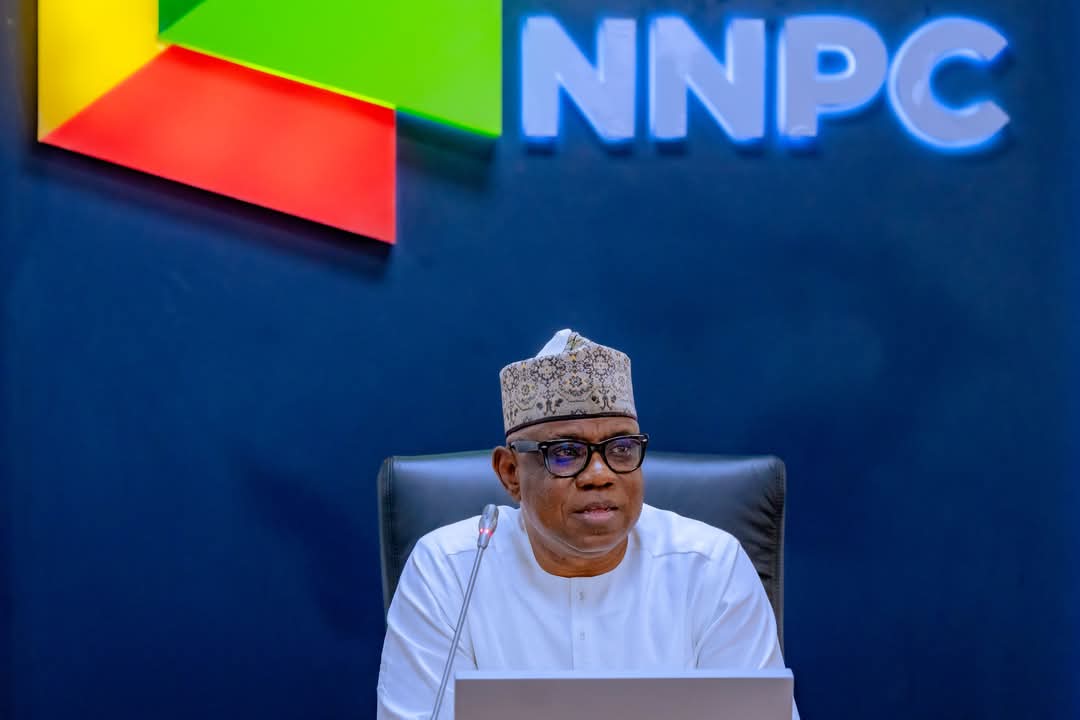
The Group Chief Executive Officer of the Nigerian National Petroleum Company Limited (NNPCL), Bayo Ojulari, has assured Nigerians that the intense competition currently reshaping the downstream petroleum sector will ultimately work in favour of consumers.
Ojulari said the price tensions being witnessed are a normal outcome of Nigeria’s shift from near-total dependence on fuel imports to increased domestic refining capacity.
“Where there is healthy competition, the buyers are the ultimate beneficiaries. And I think for us, we need to keep our minds that the market will stabilise.
“After a while, there’ll be some tension, because we’re going through a major transition,” he told journalists on Sunday after briefing President Bola Tinubu in Lagos.
His comments come amid a fierce price battle in the fuel market, which has pushed petrol prices down sharply from over N1,200 per litre in November 2024 to as low as N739 per litre at some outlets in December 2025. The decline has largely been driven by competition involving Dangote Refinery, NNPCL retail outlets and independent marketers.
“At the end of the day, I can tell you that Nigerians on the street are going to be the beneficiaries,” Ojulari said.
Explaining NNPCL’s position in the newly deregulated market, the GCEO stressed that the company no longer sets prices or regulates the sector under the Petroleum Industry Act (PIA).
“The first thing you have to know is that the PIA did something fundamental. Before the PIA in 2021, which rolled in 2022, everything was under NNPC, including some regulations. The PIA divided the roles of regulation from what I will call the business,” he explained.
According to him, regulatory responsibilities now rest with separate agencies.
“The NMDPRA is responsible for all downstream regulation and midstream, as you know, and the NUPRC is responsible for all upstream regulations.
“So it’s very important that Nigerians understand that post-PIA, we as NNPC are not regulators.”
Ojulari noted that NNPCL has been repositioned as a purely commercial entity.
“It has been instituted by the PIA to become a commercial company, which means a company that needs to compete profitably and be successful profitably,” he said, adding that the company no longer receives federation allocations and must source funding independently “like any other business.”
Competition in the downstream sector intensified after Dangote Refinery, Africa’s largest single-train refinery with a capacity of 650,000 barrels per day, commenced local petrol production in September 2024.
Data from the National Bureau of Statistics show that the average retail price of Premium Motor Spirit dropped by N153 per litre between November 2024 and November 2025, falling from N1,214.17 to N1,061.35, reflecting improved supply and stronger competition.
The price battle escalated in December 2025 when Dangote Refinery slashed its ex-depot price from N970 to N699 per litre. MRS filling stations, Dangote’s retail partner, began selling at N739 per litre nationwide, while NNPCL outlets reduced pump prices from N875 to between N825 and N840 per litre, depending on location. Independent marketers also cut prices, with some selling around N865 per litre.
Figures from Petroleumprice.ng indicate that Dangote Refinery adjusted its prices more than 20 times in 2025 alone.
However, the rapid price drops have placed pressure on marketers who purchased fuel at higher rates and are now forced to sell at a loss or risk losing customers. The Marketers Association of Nigeria confirmed that competition has become a key driver of consumer choice.
“Price competition now determines customer loyalty,” the association’s spokesperson, Chinedu Ukadike, said, noting that “any marketer unwilling to adjust prices risks losing patronage and facing mounting bank interest costs.”
Ojulari described NNPCL as “the supplier of last resort,” working with major players across the value chain, including Dangote Refinery, “in which we have an interest,” to ensure steady supply.
“For us as NNPC, our focus is to generate more production. As we generate more production, we believe there’ll be more production to feed the refineries as much as possible.
“We also believe the additional production will create more flexibility in terms of ability for downstream players to be able to participate effectively,” he said.
He acknowledged that the simultaneous operation of large-scale refineries has unsettled the market.
“To be honest with you, by the time you have a refinery like Dangote in-country, which has not been there before, with NNPC refinery now under a major relook, such a huge refinery in the country, you can expect the market will be impacted right now.
“All we need to do together is to walk through that reality,” he said.
Ojulari added that the emergence of domestic refining is a positive development, The PUNCH reports.
“Reality is a great thing to have a major refinery in Nigeria, supplying West Africa and other parts of the world.
“The question now is, how do we then ensure that the market forces stabilise so that everyone can be okay.”
He said NNPCL would allow regulators to handle competition-related issues.
“For us, we will let the NMDPRA manage the issue of competitiveness,” he said, noting that “competitiveness is not easy, and I think in these early stages, we are seeing a lot of tension with willing buyer, willing market.”
Before Dangote Refinery’s entry, Nigeria relied almost entirely on fuel imports despite being Africa’s largest oil producer, with NNPC dominating imports under a subsidy regime. The removal of fuel subsidies in May 2023 led to pump prices jumping from about N195 per litre to over N1,030 per litre by October 2024, worsening inflationary pressures.
Although the Federal Government attempted to revive the Port Harcourt refinery in November 2024, imports remained critical until Dangote significantly ramped up production in late 2024 and early 2025.
Ojulari said he updated President Tinubu on NNPCL’s operational gains in 2025, revealing that crude oil production has increased from 1.5 million barrels per day last year to over 1.7 million barrels per day currently.
“Some of those are underpinned by very structural changes within the organisation,” he said.
He added that gas production has also risen from 6.5 billion standard cubic feet per day to over 7 billion standard cubic feet.
According to him, NNPCL is targeting at least 1.8 million barrels per day in 2026, as part of efforts to meet President Tinubu’s goal of 2 million barrels per day by 2027 and attract over $30 billion in investment by 2030.
Ojulari also disclosed progress on the Ajaokuta-Kaduna-Kano gas pipeline, saying welding of the main line, including the River Niger crossing, has been completed.
“You remember sometimes in summer, we were able to cross the River Niger, which has been a struggle for many years.
“By completing this main line, what that means now is that we can begin to connect, make all the connections to the main line, which we will do in the earlier parts of next year,” he said.
The 614-kilometre AKK pipeline is expected to deliver gas to northern Nigeria for power generation, fertiliser production and industrial growth when it is commissioned in early 2026.
“We believe that we are in a good state to be able to commence the implementation,” Ojulari added.

