


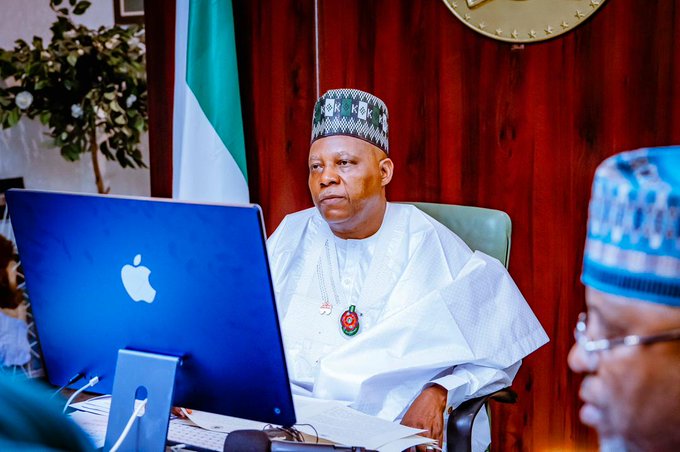
In its first high-level meeting of 2026, the National Economic Council (NEC) has unveiled a roadmap to aggressively pivot Nigeria away from oil dependency.
NEC revealed that non-oil sectors now account for a staggering 96% of the nation’s GDP.
Presiding over the 156th NEC meeting yesterday, Vice President Kashim Shettima declared that the era of “oil-first” economics is fading.
He noted that non-oil revenues now contribute nearly three-quarters of all government collections, marking a historic shift in Nigeria’s fiscal structure.
The Council received a briefing from the Minister of Finance and Coordinating Minister of the Economy, Wale Edun, who highlighted that the economy is projected to expand by 4.68% in 2026.
READ ALSO: NEC sets up committee to fast-track livestock reforms
This follows a decade-high growth rate in 2025, where the economy expanded by 3.9%.
Despite this progress, Shettima warned against “triumphalism,” noting that with a 2.6% annual population growth, Nigeria must aim even higher to decisively slash poverty and absorb inflationary shocks.
A major highlight of the meeting was the constitution of a bipartisan Presidential NEC Committee on Legacy Projects.
This team is tasked with actualising President Bola Tinubu’s vision for massive infrastructure, including the Lagos-Calabar and Sokoto-Badagry coastal superhighways.
The Committee appointed the Governor of Cross River State, Bassey Otu, as Chairman.
For regional representation, the North West is represented by the Governor of Sokoto, the North East by the Governor of Gombe, the North Central by the Governor of Niger, the South East by the Governor of Abia, and the South West by the Governor of Lagos.
The committee will focus on managing setbacks along these highways to create investment hubs and economic activities, ensuring these roads become corridors of commerce rather than just transit routes.
The World Bank briefed the Council on a new Country Partnership Framework (CPF), urging Nigeria to invest heavily in the cognitive development of children during their first 2,000 days of life.
The Council resolved to launch a state-driven Early Years Programme to reduce stunting and prepare the future workforce.
READ ALSO: NEC approves ₦100bn for security training overhaul, urges reforms with tangible impact
Additionally, a $500 million results-based program titled AGROW was presented, aimed at creating sustainable agricultural value chains.
NEC is committed to a special session in the near future to address food security and agricultural productivity specifically.
The Presidential Fiscal Policy and Tax Reforms Committee provided an update on the new tax laws intended to fix Nigeria’s “broken and fragmented” tax system.
NEC has directed states to take several key steps. First, they are urged to enact Tax Harmonisation Laws.
Second, states should adopt a “presumptive tax” regime to bring the informal sector into the tax net.
Also, they are encouraged to boost the resources and capacity of their State Internal Revenue Services.
A comprehensive conference is scheduled for February 2026 to ensure all sub-national governments are fully aligned for the robust implementation of these reforms.
As of 14 January 2026, the Excess Crude Account (ECA) held a balance of $535,823.39. The Stabilisation Account stood at ₦64.65 billion, while the Natural Resources Account had a balance of ₦97.37 billion
Shettima reminded the governors that the “consequences of choices made last year demand coherence and consistency.”
He emphasised that the “New Nigeria” envisioned by Tinubu is being built on the foundation of competitive manufacturing and export diversification.
For more details, visit New Daily Prime at www.newdailyprime.news.

