



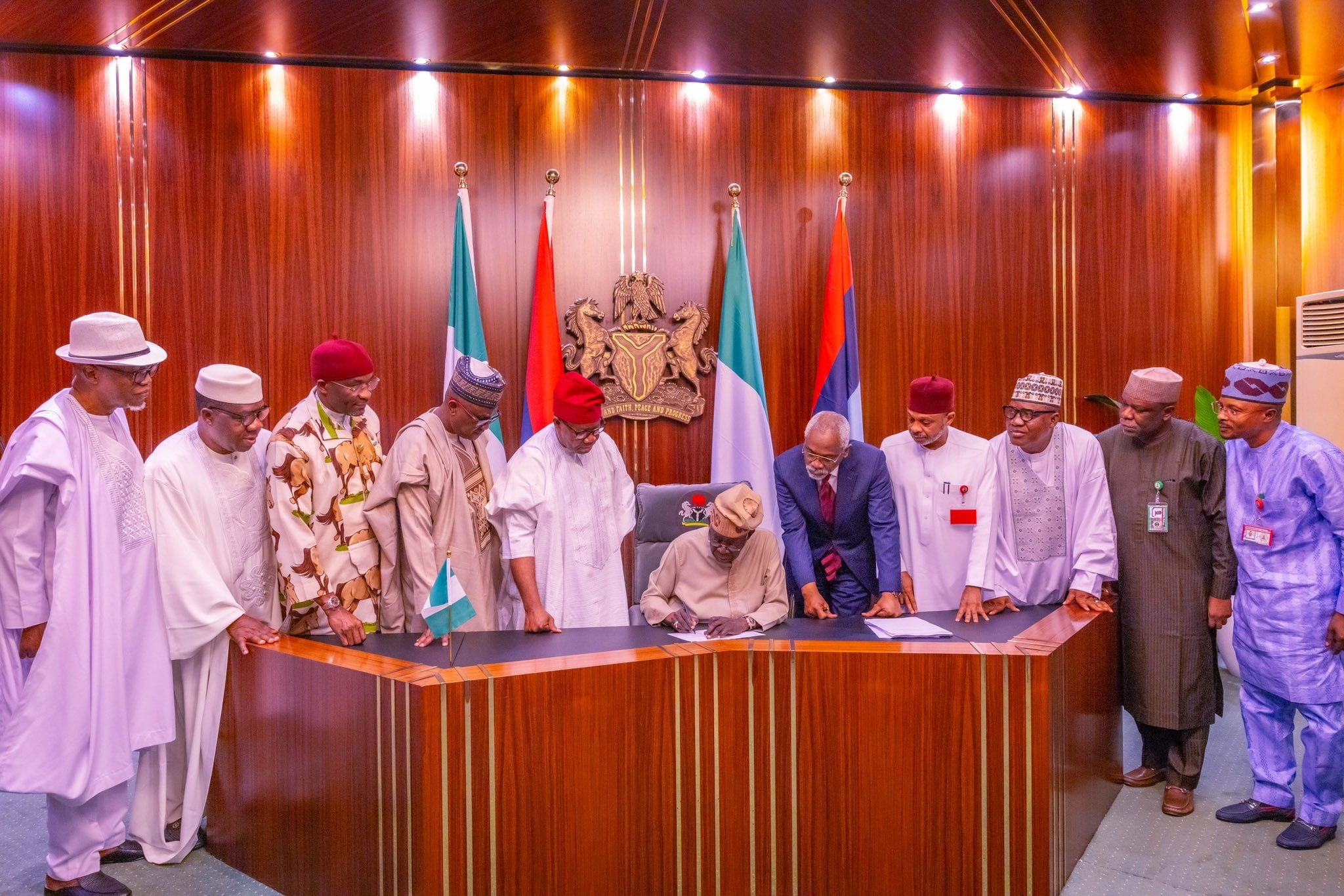
President Bola Tinubu has signed the Electoral Act 2026 (Amendment) Bill into law, concluding months of deliberations and revisions by the national assembly.
The legislation was formally endorsed at about 5:00 pm on Wednesday at the State House in Abuja, with senior leaders of the national assembly in attendance. Lawmakers had passed the bill a day earlier after revisiting contentious provisions.
Addressing guests shortly after the signing, Tinubu praised the legislature for what he described as constructive engagement in refining the law.
“The essence of democracy is to have very solid brainstorming discussions committed to national development and nation building, the stability of the nation,” he said.
The president stressed that the ultimate goal of electoral reform is to ensure clarity and fairness in the voting process, rather than merely celebrating legislative milestones.
“What is crucial is the fact that you manage the process to the extent there will be no confusion, no disenfranchisement of Nigerians; and we are all going to see democracy flourish,” he said.
Tinubu also underscored the importance of rebuilding public trust, noting that even the most advanced systems depend on human oversight.
“No matter how good a system is, it’s managed by the people, promoted by the people, and result is finalised by the people,” he said.
“For final results, you are not going to be talking to the computer. You are going to be talking to human beings who announce the results.”
On the contentious issue of real-time electronic transmission of results, the president called for a measured approach, urging stakeholders to consider Nigeria’s digital readiness, particularly broadband capacity.
“When you look at the crux of various agreements, maybe Nigeria should question our broadband capability. How technically are we today? How technically will we be tomorrow?” Tinubu asked.
He reiterated that the voting procedure itself remains largely manual.
According to him, citizens will continue to vote physically at polling units, mark their ballot papers and cast them without disruption. The sorting and counting of votes, he added, are also manual, with only the tabulated figures entered into official forms.
“Essentially, the transmission of that manual result is what we’re looking at, and we need to avoid glitches,” he said, cautioning against unnecessary complications in a digitally sensitive environment.
Expressing optimism, the president said the country would continue strengthening its democratic institutions.
“Nigeria will be there. We will flourish. We will continue to nurture this democracy for the fulfilment of our dream for prosperity and stability of our country,” he added.
Key Changes to the Law
Earlier on Tuesday, the senate reconvened in an emergency plenary session to amend aspects of the bill relating to the 2027 election timetable.
The New Daily Prime reported that lawmakers explained that the original 360-day notice period in clause 28 risked placing the presidential and national assembly elections within the Ramadan period.
The amendment has also drawn attention for its provisions on electronic transmission of results. Initially, the senate declined to make real-time electronic transmission compulsory, a decision that sparked protests at the national assembly complex.
Following renewed debate during its February 10 session, lawmakers approved the electronic transmission of results to the Independent National Electoral Commission’s result viewing portal (IReV), while retaining manual collation as a backup in cases of technical failure.
However, the revised law does not mandate real-time uploads of results.
Under the new framework, if electronic transmission is disrupted by network or communication issues, the manually completed EC8A form will serve as the primary basis for collation and declaration of results.

