



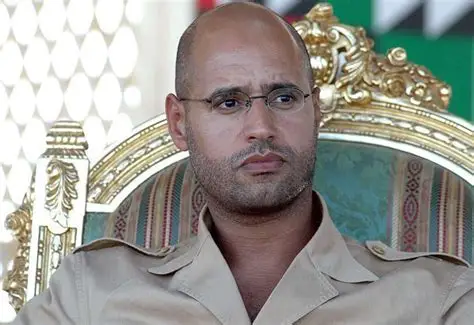
Saif al-Islam Gaddafi, the son of Libya’s former leader Muammar Gaddafi, has been shot dead at the age of 53 by four masked assailants at his home in the western Libyan city of Zintan.
For many years, Saif was regarded as his father’s heir apparent and, even after the fall of the Gaddafi regime, remained a potential force in Libya’s fractured and violent politics.
He was the subject of an arrest warrant issued by the international criminal court in 2011 and was convicted in absentia by a Libyan court in 2015 over war crimes committed during the uprising against his father’s rule. During the conflict, Saif vowed that the regime would fight the rebels “until the last man standing, even the last woman standing”.
After Muammar Gaddafi was killed later in 2011, Saif was captured while attempting to flee the country and was held for years in Zintan, initially as a prisoner. It was there that he was killed.
In 2021, with the backing of the Gaddafist “green” Popular Front for the Liberation of Libya, Saif announced his intention to run in presidential elections. His rivals feared he might win, but the vote was ultimately postponed and never took place.
In a rare interview with the New York Times that year, Saif sought to appeal to Libyans frustrated by economic hardship, insecurity and political division. He accused Libya’s postwar leaders of destroying the country, saying it was “on its knees” and describing the situation as “a fiasco”.
Saif’s life fell broadly into three phases. The first was that of a wealthy, western-educated figure who moved easily among political and business elites. Fluent in English and German, he cultivated an image as a reformer and at one point kept two pet tigers.
He pursued humanitarian initiatives at home and presented himself abroad as an advocate of gradual political reform. Western politicians and businessmen, including the former UK cabinet minister Peter Mandelson, engaged with him as a key intermediary.
This reformist image collapsed in February 2011, marking the second phase of his life, when he publicly backed his father’s violent crackdown on the uprising. In a televised address, he warned that Libya would descend into “rivers of blood” if the revolt continued.
During the Nato bombing campaign, he appeared at rallies in Tripoli, delivering fiery speeches threatening rebel-held cities. Within months, however, the regime had fallen. An estimated 15,000 people were killed during the conflict.
Muammar Gaddafi was captured and killed by rebels in Sirte in October 2011, along with Saif’s brother Mutassim. Saif himself was captured shortly afterwards while trying to reach Niger, having survived a Nato strike on a convoy he was travelling in.
He was sentenced to death by a Libyan court, though the sentence was later commuted. In 2017, he was released by the Abu Bakr al-Siddiq brigade, which controlled Zintan, following an amnesty announced by Khalifa Haftar, the eastern Libyan warlord.
Saif was born in Tripoli, the eldest of seven children from Muammar Gaddafi’s second marriage to Safia Farkash. He attended an elite school where his father’s Green Book formed part of the curriculum.
He studied engineering and architecture at Al-Fateh University in Tripoli, earned an MBA in Vienna, and later completed a PhD at the London School of Economics. A £1.5m donation to the LSE was pledged by a charity linked to him, though only £300,000 was ever paid.
Following revelations about his role in the civil war, the then LSE director, Howard Davies, resigned in 2011. Despite controversy surrounding Saif’s doctoral thesis, the university did not revoke his degree.
Saif also played a role in Libya’s rapprochement with the west in the early 2000s, including negotiations over compensation for the Lockerbie bombing and Libya’s decision to abandon its weapons of mass destruction programme.
He later accused the former French president Nicolas Sarkozy of receiving Libyan funds for his 2007 election campaign. Sarkozy was convicted of corruption in 2025.
The perpetrators of Saif’s killing have not been identified. Analysts say his return to politics may have alarmed rival power centres, including both the eastern authorities aligned with Haftar and the UN-recognised government of national unity in Tripoli.
Saif is survived by his mother, Safia, his siblings Saadi, Hannibal and Aisha, and his half-brother Muhammad. Three other brothers, Saif al-Arab, Mutassim and Khamis, died earlier.

