


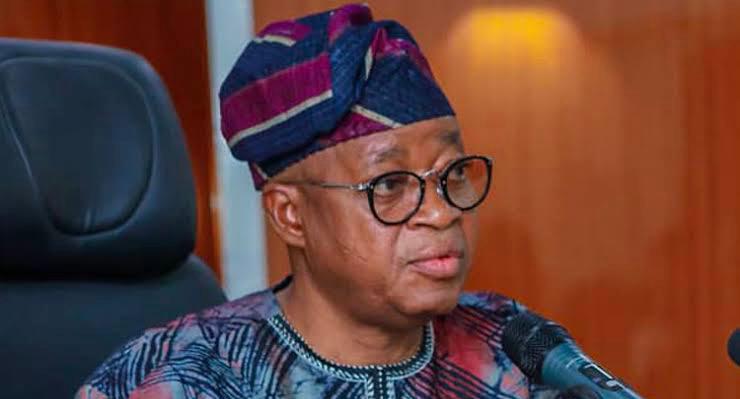
Minister of Marine and Blue Economy, Gboyega Oyetola, has warned that the ministry’s proposed N10.49 billion budget for 2026 is insufficient to effectively carry out its responsibilities in trade facilitation, transport efficiency, and food security.
The minister spoke on Tuesday while defending the budget before a joint session of the Senate Committee on Marine Transport and relevant House of Representatives committees covering ports and harbours, maritime safety, education and administration, shipping services, inland waterways, and ocean and fisheries.
Oyetola explained that the proposal consists of N8.24 billion for capital projects, N453.86 million for overhead costs, and N1.81 billion for personnel expenses. According to him, the allocation would only keep the ministry running at a basic level, without enabling significant reforms across the sector.
He noted that the ministry supervises critical subsectors — including ports, shipping, inland waterways, fisheries, and aquaculture — which account for more than 90 percent of Nigeria’s international trade by volume and play a key role in national food and nutrition security.
The minister said agencies such as the Nigerian Ports Authority (NPA), the Nigerian Maritime Administration and Safety Agency (NIMASA), and the Nigerian Shippers’ Council (NSC) are largely self-funded and remit substantial revenue to the consolidated revenue fund. However, he argued that heavy deductions at source by the office of the accountant-general of the federation have constrained their operations.
According to Oyetola, these deductions have weakened cash flow and operational flexibility, leading to port congestion, increased logistics costs, cargo delays, revenue leakages, and rising inflation.
“What looks like an accounting issue has become a national economic concern,” he said.
Oyetola also criticised the decision to place the 2026 budget of the Council for the Regulation of Freight Forwarding in Nigeria under the federal ministry of transportation, insisting that the agency should fall under the ministry of marine and blue economy.
He said the arrangement blurs oversight responsibilities and weakens policy coordination across the maritime logistics value chain.
On inland waterways, the minister called for increased funding to reduce accidents and loss of lives, noting that water transport is globally cheaper than road haulage. He said Nigeria’s heavy dependence on roads for more than 80 percent of freight movement has accelerated road damage and increased the cost of goods, adding that safer waterways would help lower logistics expenses.
Nigeria consumes over 3.6m metric tonnes of fish yearly
Addressing fisheries, Oyetola said Nigeria consumes over 3.6 million metric tonnes of fish annually but produces only about 1.4 million metric tonnes locally, leaving a shortfall that sustains imports valued at more than $1 billion each year.
He added that post-harvest losses, estimated at up to 30 percent, further reduce available supply, despite fish being one of the country’s most affordable sources of protein. He said the ministry is working to increase domestic fish production and cut dependence on imports.
Oyetola also revealed that in 2025, the ministry’s revised capital budget of N3.53 billion received an actual cash release of just N202.47 million, about 1.7 percent, while overhead releases stood at 35 percent.
He said discussions are ongoing with the ministry of budget and economic planning to close funding gaps in line with the federal government’s economic diversification agenda.
Wasiu Eshilokun, chairman of the Senate Committee on Marine Transport, said the National Assembly would thoroughly review the proposals, given the strategic importance of the marine and blue economy to the country.
During the session, Natasha Akpoti-Uduaghan, senator representing Kogi central, raised concerns about recurring oil spills and their impact on Nigeria’s blue economy goals.
“My question is going to be directed to the blue economy,” she said.
“Since 1958, Nigeria has suffered over 7,000 oil spills… our farmers and fishermen have borne the greatest burden.”
She asked whether the ministry had engaged international oil companies, including Shell, to ensure proper cleanup and environmental restoration.
“How have you, in your capacity as minister of the blue economy, engaged the various IOCs… to ensure that oil-spill cleanup activities are actually carried out?” she asked.
In response, Oyetola said responsibility for oil-spill remediation rests primarily with the ministry of environment, while stressing the importance of collaboration across ministries.
“With regard to oil spillage, it is essentially an environmental matter and falls under the purview of the ministry of environment,” he said.
“However, it is not out of place for us to synergise with the ministry of environment.”

