


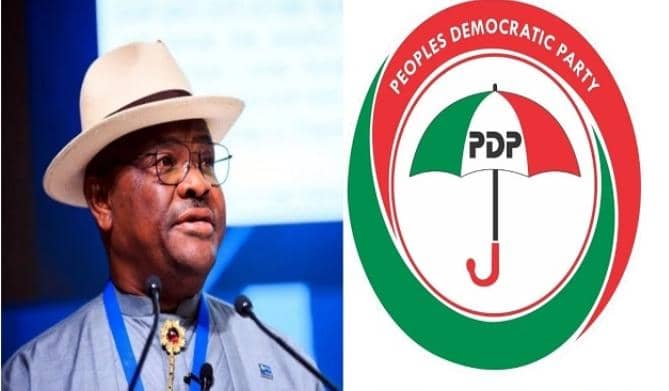
The Independent National Electoral Commission (INEC) has recognised the National Caretaker Committee of the Peoples Democratic Party (PDP) backed by the Minister of the Federal Capital Territory, Nyesom Wike.
The recognition became evident on Wednesday when the committee’s chairman, Abdulrahman Mohammed, and the party’s Acting National Secretary, Samuel Anyanwu, attended INEC’s first quarterly consultative meeting with leaders of political parties.
The meeting, organised by INEC in Abuja, is traditionally reserved for national chairmen and national secretaries of registered political parties recognised by the commission. The presence of Mohammed and Anyanwu at the session was therefore seen by observers as an implicit acceptance of the caretaker committee as the legitimate leadership structure of the PDP, at least for the purpose of engagement with the electoral body.
Read related News from New Daily Prime:
INEC Chairman flags off strategic retreat to fine-tune; Nigeria’s democracy
Wike warns striking FCTA workers to resume duties, face legal action
INEC chairman pledges free, fair, technology-driven 2027 general election
Lagos PDP reaffirms loyalty to Turaki-led leadership
INEC’s position follows a recent ruling of the Federal High Court, which directed the commission to recognise the Abdulrahman Mohammed-led caretaker committee as the authentic leadership of the opposition party. The judgment added a legal backing to the ongoing leadership realignment within the PDP, which has been the subject of internal disputes in recent months.
Meanwhile, INEC also announced the registration of two new political parties, increasing the total number of registered parties in Nigeria to 21.
The announcement was made by the Chairman of INEC, Joaish Amupitan, during the same quarterly meeting with party leaders.
According to Prof. Amupitan, the newly registered parties are the Democratic Leadership Alliance (DLA) and the National Democratic Congress (NDC).
He explained that while the Democratic Leadership Alliance met all constitutional and statutory requirements for registration, the National Democratic Congress was registered in compliance with a judgment of the Federal High Court in Lokoja, which ordered INEC to accord the party legal status.
“INEC remains committed to the rule of law and will continue to obey valid court judgments,” Amupitan said, stressing that the commission’s actions were guided strictly by legal provisions and judicial directives.
The latest developments highlight INEC’s dual role as both an electoral regulator and an institution bound to enforce court decisions, even amid complex political disputes. They also come at a time of heightened political activity, as parties position themselves ahead of future elections and internal leadership battles continue to shape Nigeria’s political landscape.
For the PDP, INEC’s engagement with the Wike-backed caretaker committee is likely to deepen debates within the party, while the registration of new parties adds fresh names to Nigeria’s already crowded political field.

