


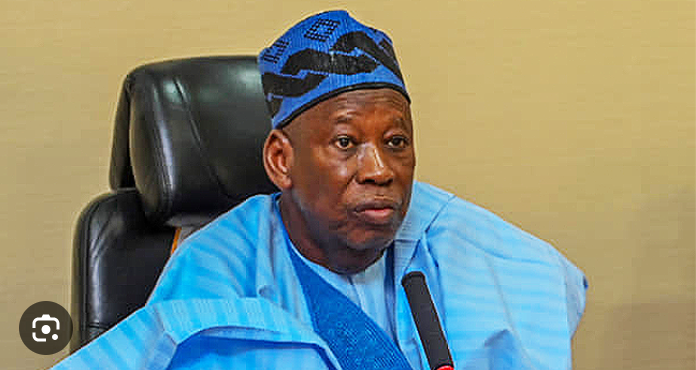
A Kano State High Court has fixed April 15 for the continuation of the trial of Abdullahi Ganduje, former governor of Kano State, and seven other defendants over allegations of large-scale misappropriation of public funds.
Ganduje is standing trial alongside his wife, Hafsat Umar, and his son, Abdullahi Umar, on an 11-count charge bordering on conspiracy, bribery, diversion and misappropriation of public funds running into billions of naira.
Other defendants in the case include Abubakar Bawuro, Jibrilla Muhammad, Lamash Properties Ltd, Safari Textiles Ltd and Lasage General Enterprises Ltd.
When proceedings resumed, the prosecution informed the court of its readiness to continue with the trial and drew attention to a motion dated November 24, 2025, seeking permission to file additional proof of evidence against the defendants.
However, defence counsel opposed moving forward, citing several pending applications that must first be resolved. Lydia Oluwakemi-Oyewo, representing the defendants, told the court that a motion dated July 17, 2025, seeking a stay of proceedings was still awaiting determination.
Adekunle Taiye-Falola, counsel to the third and seventh defendants, also referred the court to an earlier motion dated May 23, 2025.
Muhammad Shehu, who appeared for the fifth defendant, said the defence had filed an affidavit notifying the court of a separate application for a stay of proceedings at the court of appeal.
Abubakar Ahmad, counsel to the sixth defendant, informed the court that he had filed a notice of preliminary objection alongside an application for extension of time to respond on points of law dated February 2, and requested that a hearing date be set.
Faruk Asekome, counsel to the eighth defendant, however, said he was prepared to proceed with the trial.
After hearing submissions from both parties, the trial judge, Amina Adamu-Aliyu, adjourned the matter until April 15 to allow for the hearing of all pending applications and preliminary objections.
The case has faced repeated delays due to procedural and jurisdictional challenges. The Kano State High Court had earlier ruled that it had the authority to hear the matter, dismissing preliminary objections raised by the defence as “incompetent”.
That decision was challenged at the Kano division of the court of appeal, where the defendants argued that the trial court lacked jurisdiction. In October 2025, however, the appellate court struck out the appeal after finding that the record of appeal was not properly transmitted.

