


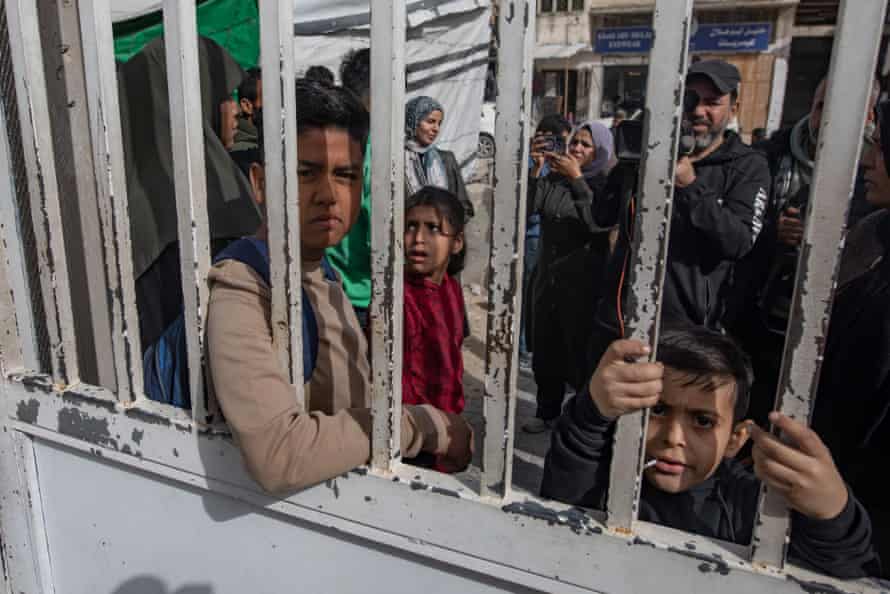
A small number of sick and wounded Palestinians have begun crossing into Egypt for medical treatment after Israel allowed a limited reopening of Gaza’s Rafah border crossing, raising cautious hopes amid fragile diplomatic efforts to stabilise the conflict.
Egyptian officials said about 150 people were expected to leave Gaza on Monday, with 50 permitted to enter, more than 20 months after Israeli forces closed the crossing.
By nightfall, however, only 12 Palestinians had been allowed back into the territory, according to Palestinian and Egyptian sources cited by Reuters. A further 38 failed to clear security checks and were forced to remain overnight on the Egyptian side.
Israel permitted five patients, each accompanied by two relatives, to cross into Egypt. That brought the total number of people allowed through the crossing in either direction to 27. Palestinian officials blamed delays on Israeli security procedures. Israel’s military offered no immediate comment.
Ambulances were seen waiting for hours at the border before transporting patients after sunset, footage broadcast by Egyptian state television showed.
The Rafah crossing has been closed since Israeli troops seized it in May 2024. It was only briefly reopened during a ceasefire in early 2025 to allow limited medical evacuations.
Gaza health officials say about 20,000 children and adults in need of urgent medical care are hoping to leave through Rafah. Thousands of Palestinians currently outside the territory are also seeking to return home.
When Israel took control of the crossing, Gaza’s only border not shared with Israel, it said the move was necessary to prevent weapons smuggling by Hamas. The closure effectively isolated the territory, cutting off a vital route for medical treatment, travel and trade.
Israel has made clear that movement through the crossing will remain tightly restricted. All crossings are subject to joint Israeli-Egyptian security screening, and only a small number of patients will be allowed to leave each day.
Thousands of civilians have registered with the World Health Organization for evacuation. Médecins Sans Frontières said more than one in five are children. Among the sick are more than 11,000 cancer patients.
Israeli airstrikes have devastated Gaza’s healthcare system. In March 2025, Israel destroyed the territory’s only specialised cancer hospital, leaving doctors to work from makeshift clinics with few diagnostic tools or supplies.
Gaza health officials said around 4,000 people with official referrals for treatment abroad have been unable to cross the border.
For some, permission came too late. Dalia Abu Kashef, 28, died last week while waiting to cross into Egypt for a liver transplant. Her husband, Muatasem El-Rass, told Reuters that her brother had volunteered to donate part of his liver, but delays at the crossing proved fatal.
“We were waiting for the crossing to open so we could travel and do the surgery,” he said. “She deteriorated badly and died.”
The WHO says at least 900 people, including children and cancer patients, have died while awaiting evacuation.
The partial reopening of Rafah also offers a rare chance for families separated by more than two years of war to reunite. In the early months of the conflict, before the crossing was sealed, about 100,000 Palestinians crossed into Egypt.
“I love Gaza, and I don’t see any other place that feels like home,” said Mohammad Talal, 28, whose house in Jabalia was destroyed. “Going back to live in a tent? I don’t care. I can’t wait to take my father into my arms.”
Israel had previously kept Rafah closed as leverage, linking its reopening to the return of all hostages taken during the Hamas-led attack of 7 October 2023. That position shifted last week after the Israeli military said it had recovered the remains of the final captive, Ran Gvili, a police sergeant killed during the initial assault.
The reopening is viewed as a key step as a US-brokered ceasefire enters its second phase. The first phase involved hostage exchanges, increased humanitarian aid and a partial Israeli troop withdrawal.
The second phase is expected to be more complex, including plans for a new Palestinian governing body in Gaza, the deployment of an international security force, the disarmament of Hamas and the start of reconstruction.
The EU’s foreign policy chief, Kaja Kallas, described the reopening as “a concrete and positive step” in the peace process. She said an EU civilian mission was monitoring operations and supporting Palestinian border officials.
The National Committee for the Administration of Gaza welcomed the move but cautioned against overestimating its impact. In a statement, it described the reopening as symbolic, calling it “the beginning of a long process to reconnect what has been torn apart”.
Despite the development, the ceasefire remains fragile. Airstrikes and gunfire have slowed but not stopped, while storms have caused flooding and deaths in overcrowded displacement camps.
On Saturday, Israeli airstrikes killed at least 32 people, including several children, according to local health officials. Israel said the strikes targeted militants and weapons sites.
Since the ceasefire took effect in early October, Israeli forces have killed at least 509 Palestinians and wounded more than 1,400 others, many of them children.
Israel continues to bar foreign journalists from entering Gaza. International coverage, including reporting for the Guardian, relies entirely on local journalists, hundreds of whom have been killed since the war began.

