


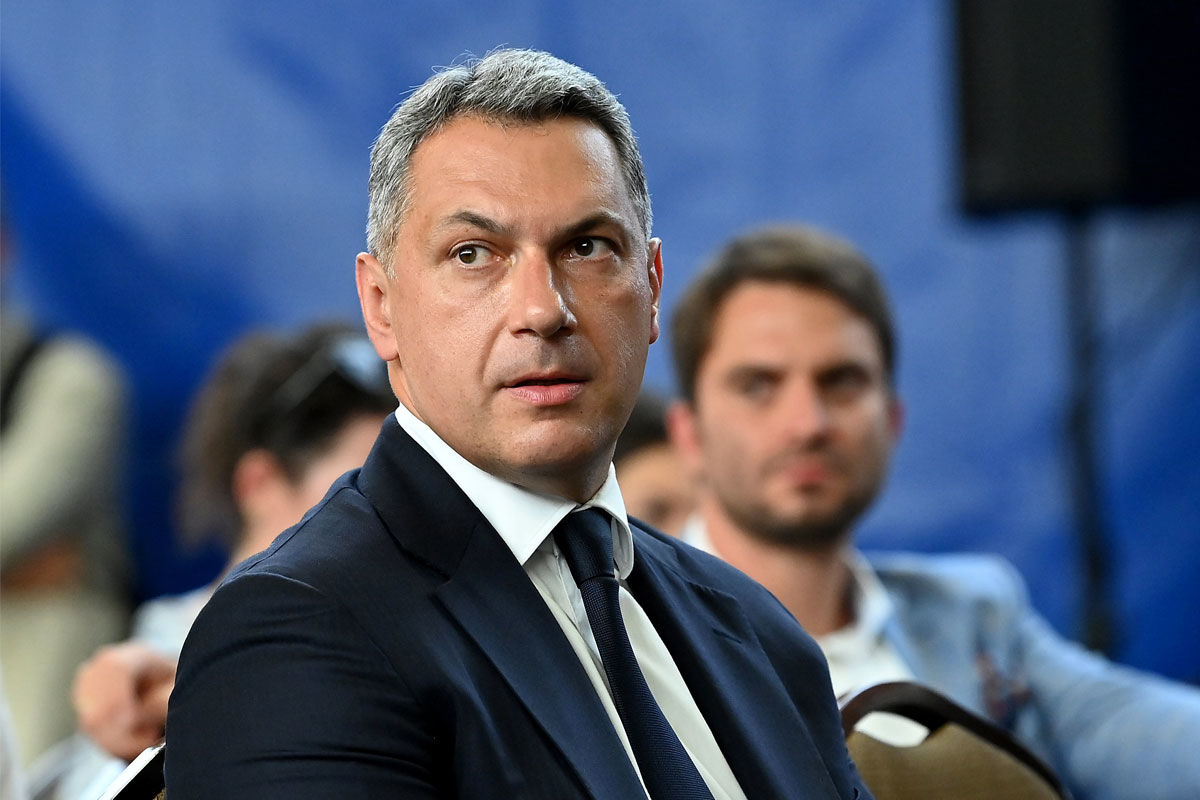
Thousands of people are expected to gather in Budapest on Saturday to demand the resignation of a senior Hungarian politician over racist remarks directed at Roma people earlier this month.
János Lázár made the comments at a political forum while arguing that migration was not a solution to Hungary’s labour shortage. Referring to cleaning work on intercity trains, he said Roma people would do the job, using an offensive slur.
The remarks, recorded on video, quickly circulated online and prompted a strong backlash. Roma organisations, civil society groups and opposition politicians called on Lázár to apologise and step down.
“He has crossed all boundaries,” said Péter Magyar, leader of the opposition Tisza party.
The controversy comes just 10 weeks before an election that could determine whether Viktor Orbán’s Fidesz party retains power. Fidesz has governed Hungary since 2010.
Ádám Lakatos, an 18-year-old Roma activist organising Saturday’s protest, said the party’s time in power was coming to an end. “Fidesz is over. Its mandate has expired permanently,” he said.
Recent opinion polls show Tisza, a centre-right party founded in 2020, holding a steady lead over Fidesz. Analysts say the backlash over Lázár’s comments could further push undecided voters away from the governing party.
Lázár has apologised for the remarks but has refused to resign. He has since appeared alongside Orbán at a party event. He did not respond to a request for comment.
Roma communities in Hungary have long faced discrimination and social exclusion. They experience higher poverty levels, poorer living conditions and shorter life expectancy than the general population.
“During its years in power, Fidesz has failed to create jobs or provide meaningful support for Roma families,” said Szandi Minzári, a policy expert with Roma heritage. She said Roma people are disproportionately employed in low-paid public work schemes, which can leave them vulnerable to political pressure.
Independent organisations have raised concerns that these public employment programmes are sometimes used by local officials to influence voters.
Bernadett Orbán, a Roma rights activist, said Lázár’s resignation could help repair relations between Fidesz and Roma voters. “It would send an important message,” she said. “But I don’t believe he will resign.”
She and her partner, Tamás Könyves, who are not Roma, plan to attend the protest. Könyves, 51, will address the crowd. “I feel a responsibility to stand up for the Roma community,” he said.
Public anger towards Fidesz has grown in recent years. In 2024, Hungary’s president, Katalin Novák, resigned following mass protests over the pardon of a man convicted of covering up child sexual abuse at a state-run orphanage.
Further demonstrations followed in 2025 after reports of systemic abuse at a juvenile correctional facility, with opposition parties calling for resignations within the government.
“Fidesz’s actions have become unacceptable for Hungarians, for Europe and for the wider world,” said Lakatos, who grew up in state care.
According to Tibor Závecz of the Závecz Research Institute, both main parties have expanded their support over the past year, largely at the expense of smaller parties rather than undecided voters.
He said Fidesz appeared to be drawing support from the far right. While anti-Roma rhetoric might appeal to those voters, it risks alienating hundreds of thousands of undecided citizens.
Balázs Böcskei, research director at the Idea Institute, said it was striking that Fidesz’s campaign had failed to significantly improve its standing. He attributed this to a strong opposition and a series of policy failures affecting the economy and welfare services.

