



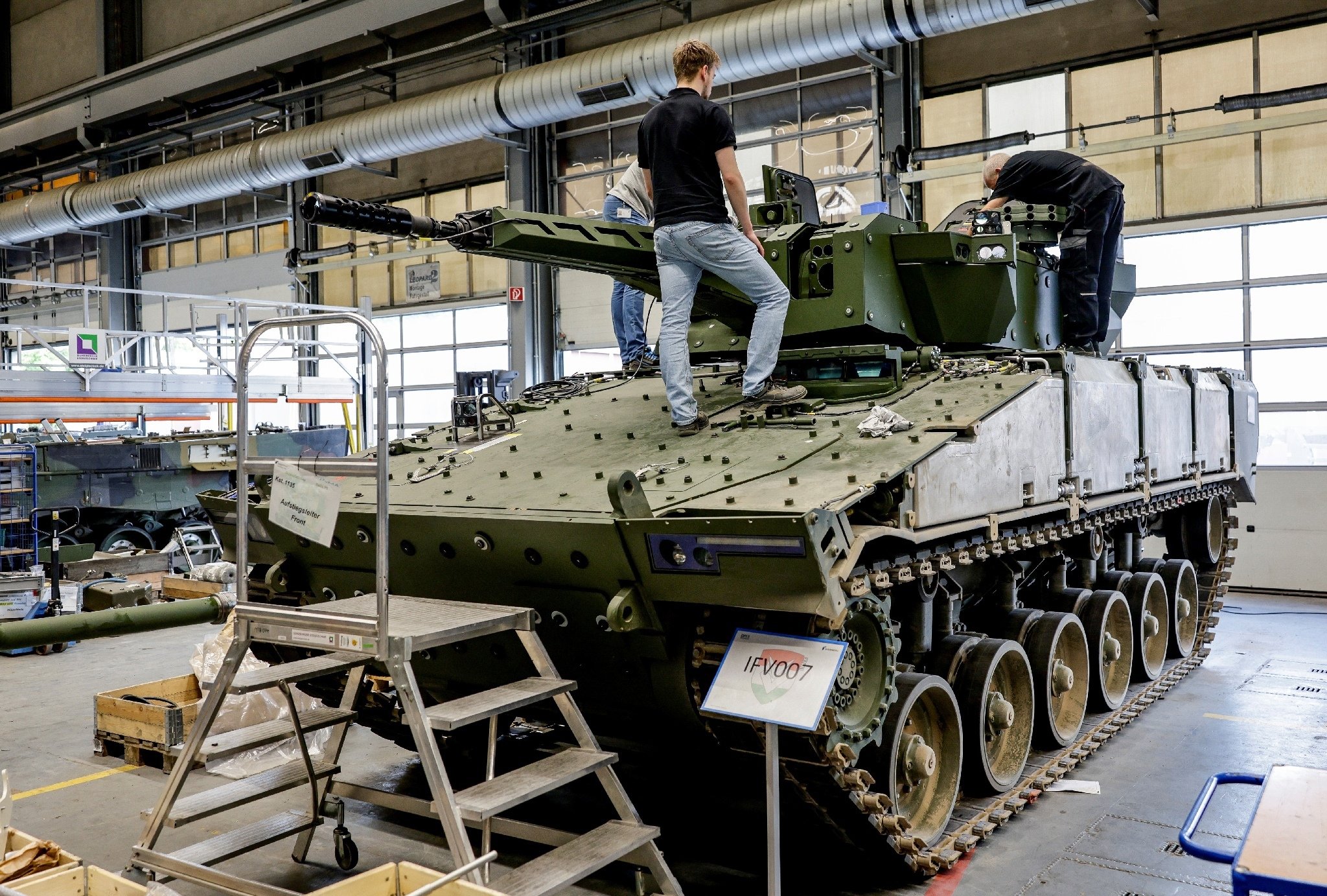
Europe has embarked on a large-scale revival of its defence industry to reduce its long-standing dependence on the United States and strengthen its capacity to respond to Russian aggression. The renewed push, driven by security concerns following Russia’s invasion of Ukraine, marks the most significant expansion of European defence production in decades.
According to estimates cited by The Wall Street Journal, it would cost Europe around $1 trillion to fully replace US military capabilities on the continent. While that goal remains long-term, Europe’s defence industry—long criticised for underinvestment and fragmentation—is now operating at full capacity.
Production of drones, tanks, missiles, and ammunition is accelerating at its fastest pace in decades. Analysts at Bernstein estimate that Europe spent about $560 billion on defence in 2025, double the amount recorded ten years earlier. By 2035, European spending on military equipment is projected to reach roughly 80 per cent of the level currently spent by the US Pentagon.
For more details, visit New Daily Prime at www.newdailyprime.news
Major defence manufacturers are expanding rapidly. Germany’s Rheinmetall has opened or is building 16 new factories across Europe, while Italy’s Leonardo has increased its workforce by almost 50 per cent. Missile production at MBDA has increased several times, reflecting rising demand from European governments.
In the Baltic region, Estonia has emerged as a global leader in ground-based drone production, highlighting how smaller European states are also benefiting from the surge in defence investment.
In some areas, Europe is already outperforming the United States. Rheinmetall is expected to reach an annual production capacity of 1.5 million artillery shells—more than the total output of the entire US ammunition industry. Europe is also largely self-sufficient in producing armoured vehicles, naval ships, and submarines.
However, significant challenges remain. France’s Dassault Aviation is struggling with a backlog of unfulfilled orders for Rafale fighter jets. At the same time, Poland has turned to South Korea to meet its immediate defence needs, purchasing tanks and other equipment outside Europe.
Europe also continues to lag behind the US in several critical areas, including stealth aircraft, long-range missiles, and satellite reconnaissance capabilities. To address these gaps, European countries are pursuing new projects, including developing missiles with ranges exceeding 1,500 kilometres after 2030. The United Kingdom has also launched efforts to build its own satellite system.
Dependence on American components remains a concern. Finland has warned that its fighter jets would be unable to operate in the long term without access to US spare parts. President Alexander Stubb recently acknowledged that such reliance poses strategic risks.
France, meanwhile, claims it currently provides around two-thirds of Ukraine’s satellite reconnaissance, underlining Europe’s growing, though still uneven, strategic capabilities as it works to assert greater defence autonomy.

