


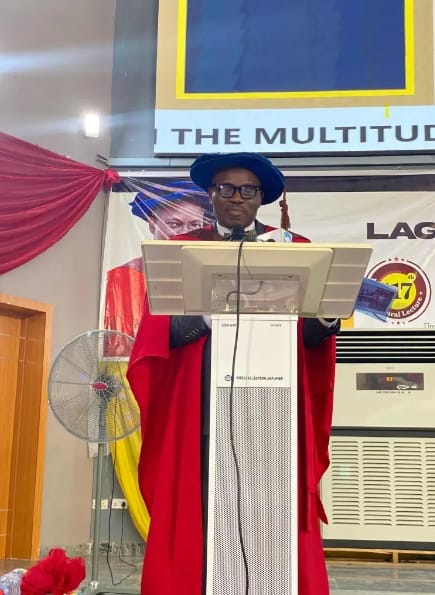
By Sakariyah, Ridwanullah
Professor Olutumbi Ayodele, of the Department of English, Faculty of Arts, Lagos State University (LASU), has called on the Federal Government to urgently institutionalise a national language policy to strengthen unity and national cohesion.
Prof Ayodele delivered the 117th inaugural lecture of LASU at the Buba Marwa Auditorium, Ojo campus, on Tuesday, January 27, 2026, under the theme: “In the Multitude of Tongues: Leveraging Language Systems for National Brotherhood.”
The distinguished linguist emphasised that language is more than a tool for communication; it is the framework through which societies think, interact, and progress. He argued that Nigeria’s linguistic diversity, if properly managed, could become a source of unity rather than division.
“Nigeria must develop and rigorously implement a functional and inclusive national language policy that recognises English as our common thread, yet honours the richness of our indigenous tongues as carriers of culture and identity. Such a policy must be enshrined in law and aligned with national development goals,” Prof Ayodele said.
He warned that the neglect of indigenous languages, often relegated as “vernacular,” threatens the soul of the nation.
The professor outlined practical steps for realising this vision. He advocated the integration of critical literacy in education, enabling citizens to analyse, question, and respond constructively to governance and political discourse. According to him, democracy thrives only when people can think beyond slogans and engage in informed debates that promote national interest.
He also called for the re-engineering of legislative language.
Parliamentary debates and laws, he said, must be clear, accessible, and inclusive to bridge the gap between government and citizens. In the same vein, he urged the enhancement of English language pedagogy beyond grammar and exams, focusing on functional, communicative, and socio-cultural skills to prepare Nigerians for professional, civic, and diplomatic engagement.
Prof Ayodele further recommended that public institutions adopt discourse awareness training, ensuring that officials communicate in ways that unite rather than divide. He stressed that policy communication should not only convey information but also inspire shared purpose, fostering a sense of belonging among citizens. He added that media ethics and critical discourse awareness should be made compulsory for journalists, broadcasters, and digital content creators, with regular refresher courses to keep pace with the rapidly evolving media landscape.
While highlighting the importance of research, he proposed evidence-driven language planning and the establishment of a National Language Academy.
The centre, he said, would promote multilingual education, develop a national lingua franca, advance indigenous languages, and guide policies that are culturally sensitive and socially inclusive. It would also serve as a hub for continuous study of language use in governance, media, education, and social life.
Speaking on political discourse, Prof Ayodele urged politicians and parties to adhere to ethical communication codes in order to curb hate speech, incitement, and divisive rhetoric. He recommended structured training for officeholders, internal codes of conduct for political parties, and independent monitoring bodies to recognise responsible language use, while publicly addressing violations.
In his concluding remarks, Prof Ayodele noted that language is not merely a medium of communication but a mechanism for national unity. “When language policies are inclusive, they can break down barriers between groups, foster trust, and create a cohesive society. Let us use our words not as weapons, but as bridges that heal; not as tools of division, but as channels of understanding,” he said.
He called on all Nigerians, ranging from scholars, educators to citizens, to steward language with wisdom and integrity, with a view to transforming Nigeria’s many tongues into a symphony of voices celebrating unity in diversity.
He reminded the audience that the future of national cohesion depends not only on government action but also on individual commitment to respectful and inclusive communication in every sphere of life.
Prof Ayodele concluded that the real test of nationhood lies in how language is used to unite people, shape thought, and strengthen democratic culture. He urged policymakers, educators, media practitioners, and ordinary citizens to see language as a bridge that is capable of linking Nigeria’s diverse communities into a single, harmonious whole.
For More Details, Visit New Daily Prime at www.newdialyprime.news

