


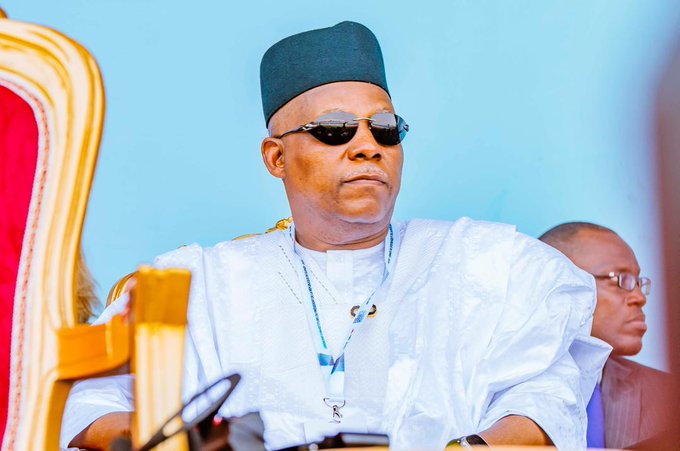
Vice President Kashim Shettima arrived at the Nnamdi Azikiwe International Airport on Saturday, marking the successful conclusion of a week-long diplomatic and economic marathon in Guinea-Conakry and Switzerland.
Upon his return, he declared that Nigeria has decisively reclaimed its “frontline seat” in global and regional policy discussions, signalling a new era of economic assertiveness under President Bola Tinubu’s “Renewed Hope” agenda.
The mission began in Conakry, where Shettima represented Tinubu at the inauguration of Guinea’s President, Mamadi Doumbouya.
READ ALSO: Shettima commissions ‘Nigeria House’ at 2026 WEF
The visit served two primary purposes. It reaffirmed Nigeria’s role as a stabilising force within the Economic Community of West African States (ECOWAS) and sought to open new bilateral opportunities for Nigerian-manufactured goods and agricultural exports in the Guinean market.
From West Africa, the Vice President led the Nigerian delegation to the 56th World Economic Forum (WEF) in Switzerland.
A historic milestone of the trip was the commissioning of Nigeria House Davos—the nation’s first-ever sovereign pavilion on the famous Davos Promenade.
The pavilion is set to serve as a permanent hub for global investors to explore Nigeria’s potential in solid minerals, the digital economy, and agriculture.
During a high-level session titled “When Food Becomes Security”, he presented Nigeria’s new national food security framework, positioning the agricultural sector as a vital pillar of macroeconomic stability.
On the financial front, Shettima shared optimistic data with international investors, noting that the nation’s economy was stabilising.
He said GDP growth was projected at 4.4% in 2026 and pointed to a significant decline in inflation to 12.94%.
He also highlighted Nigeria’s transition to a net exporter of refined petroleum products, supported by the operations of the Dangote Refinery.
Beyond official WEF sessions, Shettima joined former President Olusegun Obasanjo, former Vice President Yemi Osinbajo, and Finance Minister Wale Edun to push the Accra Reset Initiative.
READ ALSO: Shettima declares food security a ‘national security priority’
This African-led forum advocates for industrialisation funded by domestic capital and local value chains, moving away from the traditional dependency on foreign aid.
“Nigeria is no longer just an observer; we are active participants with a clear sense of purpose,” he remarked, summarising the impact of the mission.
For more details, visit New Daily Prime at www.newdailyprime.news

