


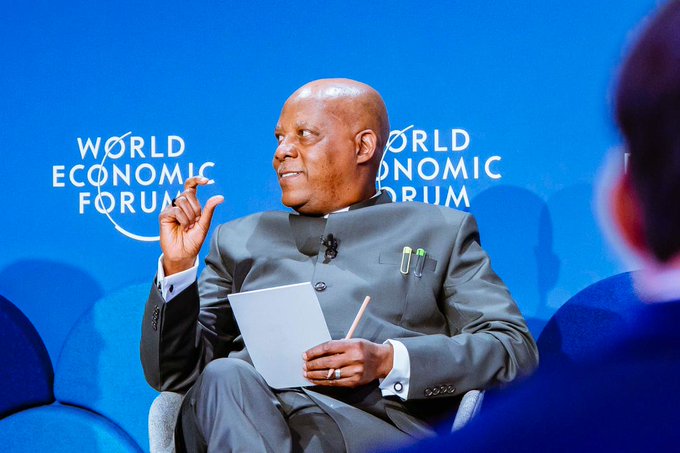
Vice President Kashim Shettima has unveiled Nigeria’s multi-dimensional macro-strategy for food security at the 56th World Economic Forum (WEF).
Addressing global leaders on Thursday, he declared that the President Bola Tinubu administration has moved beyond treating agriculture as a standalone sector, reframing food security as a vital pillar of macroeconomic stability and national governance.
Speaking at a high-level panel titled “When Food Becomes Security,” Shettima argued that a nation’s ability to feed itself is inextricably linked to its internal peace and economic resilience.
READ ALSO: Replacing Shettima would be political suicide for Tinubu, APC chieftain
“In Nigeria, we don’t look at food security purely as an agricultural issue. It is a macroeconomic, security, and governance issue,” he stated. “Our focus is to use food security as a pillar for national security, regional cohesion, and stability.”
He said the Federal Government’s roadmap was anchored on three core objectives aimed at shielding Nigeria from global supply chain shocks.
Shettima added that the government plans to aggressively boost production by scaling up the cultivation of staple crops.
He said FG seeks to build environmental resilience by addressing what he described as the “incestuous relationship” between the economy and ecology through the deployment of climate-smart solutions.
According to him, the roadmap prioritises regional integration by strengthening ties within West Africa to create a unified food market.
To combat the twin threats of insecurity and rising food prices, he announced the “Back to the Farm Initiative.”
This programme is designed to return displaced farmers to their ancestral lands by providing fortified farming zones protected by community-based security engagements, and direct access to capital, agricultural insurance, and modern inputs like drought-resistant and early-maturing seeds.
Shettima identified Nigeria’s heavy reliance on imports for wheat, sugar, and dairy as a primary driver of foreign exchange (FX) volatility.
READ ALSO: Shettima commissions ‘Nigeria House’ at 2026 WEF
By promoting local substitutes such as sorghum, millet, and cassava flour, the government aims to reduce the pressure on the Naira and lower inflation.
Shettima assured international investors that Nigeria is ready for large-scale agricultural business.
He noted that under Tinubu’s Renewed Hope Agenda, the government is on track to make smallholder farmers and fishers “investable at scale” within the next 12 months.
On the continental front, Shettima urged African nations to maximise the African Continental Free Trade Area (AfCFTA).
He predicted that the coming months would see intra-African trade soar well beyond the current 10.7% as Nigeria leads by example in climate adaptation and local production.
“The African giant has woken up from its slumber,” Shettima concluded, signalling a new era where the farm is the frontline of Nigeria’s economic defence.
For more details, visit New Daily Prime at www.newdailyprime.news.

