


By Jeremiah Aminu
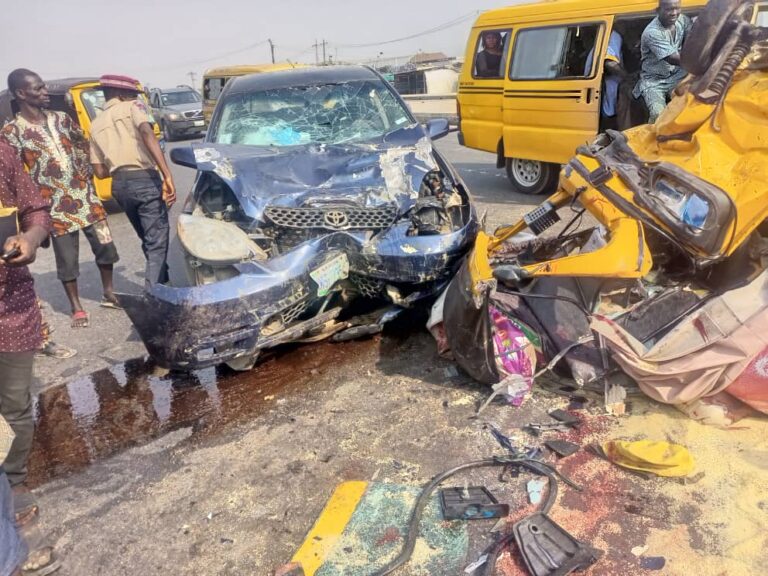
Nigerian roads have, in recent years, become breeding grounds upon which accident casualties thrive.
Recent statistical reports from the National Bureau of Statistics (NBS) and the Federal Road Safety Corps (FRSC) serve as testaments to this gruesome fact, as they reveal the alarming rate in which accident casualties (both ghastly and fatal) occur on Nigerian roads.
On the one hand, the NBS, in a 2023 Social Statistics report, recorded over 18,386 cases of road accidents in a span of three years, with 5472 incidents in 2020, 6336 in 2021, and 6578 in 2022. Much more recently in 2025, FRSC, on the other hand, documented over 5281 cases of road accidents across Nigeria between the months of January and June.
Shehu Mohammed, the Corps Marshal, also corroborated this in a media briefing during the 2025 Half-Year Strategy Session at Abuja where he stated that:
“Available statistics reveal that the first half of 2025 has presented a tough challenge. Between January and June, 5,281 road traffic crashes occurred across the country, involving 39,793 people. Sadly, 2,838 lives were lost while 17,818 were rescued. This represents an increase in crashes by 3.9 per cent and a rise in fatalities by 2.2 per cent”.
To proceed, while these accident incidents can be attributed to various causal factors, some of which include poor road infrastructure, drunk driving, and route violations, overspeeding and the misconduct of traffic agencies stand as principal problems contributing to the continuance of road accidents in Nigeria.
Beginning with overspeeding, it is said to be the prime factor responsible for most cases of accidents on Nigerian roads. According to statistical data from the NBS, speed violations resulted in the occurrence of over 18,000 cases of road accidents within a span of three years. Discussing extensively on this issue, Charles Obiowo, in a Nairametric report, provided a detailed statistical breakdown derived from NBS statistical records:
“In 2020, the report documented 11,875 road traffic crashes, with 2,961 being fatal, 7,627 resulting in serious injuries, and 1,347 involving minor injuries. These accidents led to 33,311 injuries and 5,601 deaths.
In 2021, there were 13,027 road traffic crashes, with 3,218 fatal incidents, 8,324 causing serious injuries, and 1,485 involving minor injuries. This resulted in 38,075 injuries and 6,205 deaths.
In 2022, the report showed 13,656 road traffic crashes, with 3,309 being fatal, 8,953 resulting in serious injuries, and 1,394 involving minor injuries. These accidents led to 38,930 injuries and 6,456 deaths”.
Asides speed violations, the misconduct of traffic operatives is another factor that contributes to the frightening figures of road accidents in Nigeria. Traffic law enforcement bodies such as the Lagos State Traffic Management Authority (LASTMA) and the Federal Road Safety Corps (FRSC) have, in some instances, contributed to accident fatalities that they have been tasked to prevent from occurring.
Instead of focusing on effectively regulating traffic on Nigerian expressways, they engage in acts of bribery by extorting money from traffic offenders. Sometimes, traffic offenders attempt to evade arrest or fine imposition by fleeing the scene. This results in hot pursuits that lead to fatal cases of road accidents.
As an instance, Titilope Joseph, an Independent Newspapers reporter, revealed how an extortion-driven chase by FRSC officers in 2023 resulted in a tragic accident that claimed the lives of three pedestrians in Onitsha, Anambra State:
“…in Onitsha, Anambra State, in 2023, FRSC officers pursued a commercial driver for having an expired vehicle licence. The high-speed pursuit ended when the driver lost control and collided with a crowd of pedestrians, killing three people on the spot”.
During an interview with eyewitnesses, they expressed their displeasure following the unfortunate incident, stating that it could have been avoided if the officers had issued a ticket to the driver instead of engaging in a cat-and-mouse chase. Thus, the foregoing marks the misconduct of traffic operatives as one of the leading factors contributing to the increasing rate of accident lethalities in Nigeria.
It is in light of these alarming rates of accident casualties that certain regulatory measures have been put in place by the government and security operatives to ensure their reduction.
For instance, the Lagos State Government, in February 2025, collaborated with Huawei Technologies to facilitate the installation of speed limit monitors on Lagos roads. In a press briefing, Oluwaseun Osiyemi, the Lagos State Commissioner for Transportation, commented that the purpose of these monitors is:
“…to save lives, protect property, and create an orderly transportation environment. This system is not designed to be punitive but to encourage responsible driving behaviour and reduce the rate of accidents on our roads”.
He also added, “The fine for violating a red light is N20,000, while the fine for exceeding the speed limit is N50,000. Motorists who violate traffic laws, as detected by the ITS, will receive SMS notifications from the Vehicle Inspection Service department, detailing the nature of the violation and the corresponding fines to be paid”.
The Federal Road Safety Corps (FRSC) are not left out of the equation, as they have also promised to enforce stricter actions regarding speed violation offences. The Corps Marshal for FRSC, Shehu Mohammed, warned that: “The Corps will no longer tolerate reckless driving. We will take drastic action against any violator”.
To bring this article to a close, Nigerian roads are fast becoming corridors of death that claim thousands of lives every year. Among several causal factors, overspeeding and the misconduct of traffic agencies actively contribute to the progression of this distressing problem.
Despite the fact that the government and security operatives have implemented preventive measures that are aimed at reducing this public safety issue, more practical measures still need to be put in place, nonetheless, to address other leading factors responsible for the rising rates of accidents in Nigeria.
For More Details, Visit New Daily Prime at www.newdailyprime.news

