



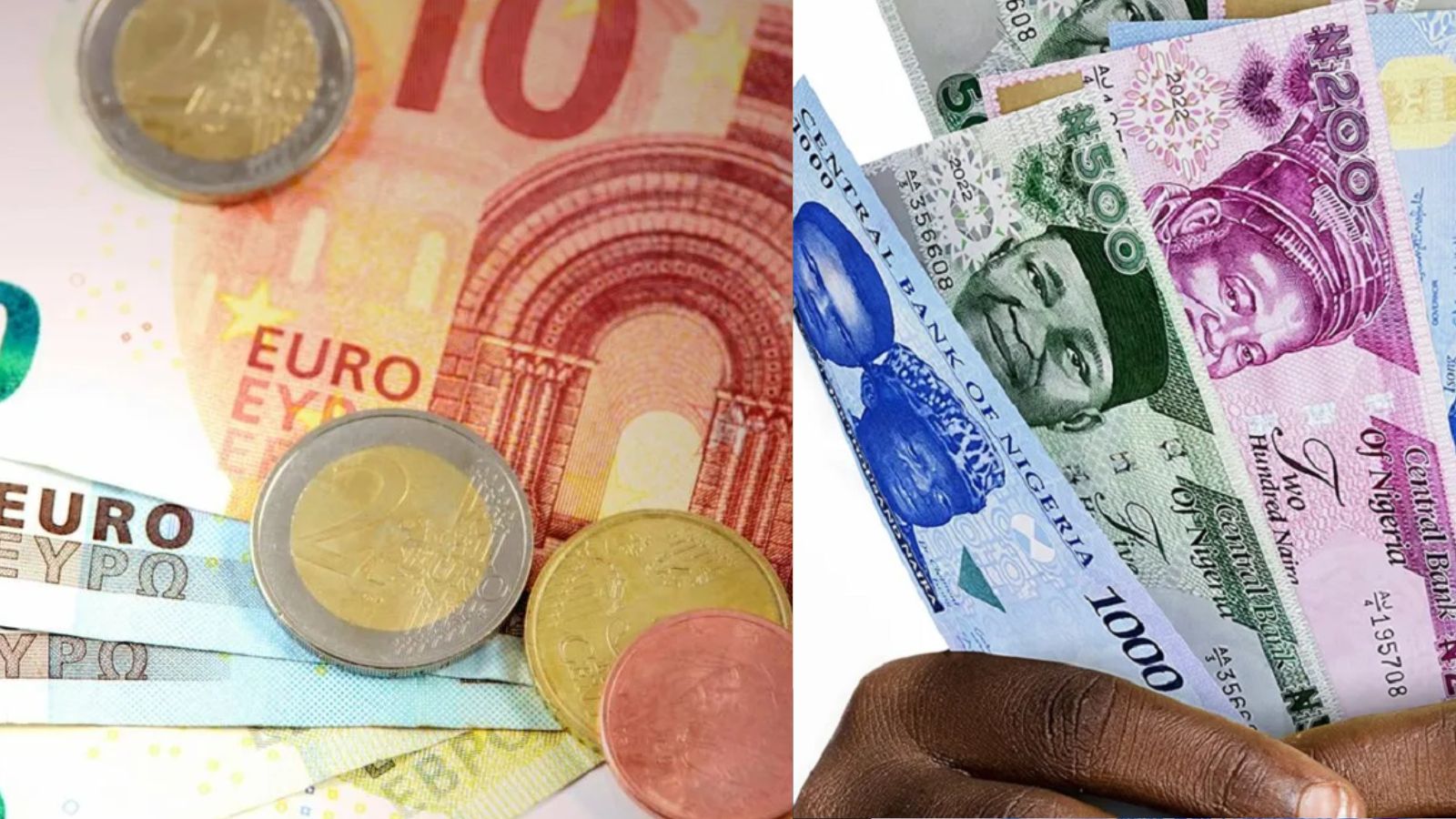
Nigeria’s foreign exchange market recorded a split performance for the Euro on January 8, as fresh data from the NGNToday platform revealed diverging movements between the official market and the parallel segment.
While the official rate reflected a noticeable adjustment, the black market maintained a largely unchanged posture, underscoring the uneven pace of currency price discovery across the FX landscape.
At the official exchange window, the Euro was quoted at N1,660, representing a depreciation from the N1,667 recorded on 7 January.
This shift indicates a modest softening of the Euro against the naira within the regulated market, suggesting either an easing in demand pressure or a short-term improvement in FX supply.
Market analysts note that official rates are often influenced by administrative controls and targeted interventions, which can result in day-to-day fluctuations that do not always mirror broader market sentiment.
Conversely, the black market rate for the Euro stood at N1,715 on Thursday. According to NGNToday, this level reflects relative stability in the parallel market, as traders largely maintained their previous pricing positions despite movements at the official window.
On the previous day, the Euro exchanged around N1,680 in the informal market, and although today’s figure remains elevated, the absence of sharp volatility suggests cautious trading rather than aggressive repricing.
The differing trajectories once again highlight the persistent gap between Nigeria’s official and unofficial FX markets.
Despite ongoing reforms aimed at enhancing transparency and improving access to foreign currency, demand pressures in the parallel market continue to outweigh supply, keeping rates significantly higher than official benchmarks.
Import-dependent businesses, international travellers, and individuals seeking FX outside formal channels remain key drivers of activity in this segment.
Financial analysts point out that Thursday’s official depreciation of the Euro could be linked to short-term liquidity adjustments or reduced institutional demand. In some cases, improved access to FX for selected sectors can temporarily strengthen the naira at official windows, even when underlying structural challenges remain unresolved.
However, the parallel market, which is largely sentiment-driven, tends to respond more slowly to such signals, especially in the absence of sustained inflows.
The continued disparity between the two markets carries implications for pricing, inflation, and business planning. Companies that rely on the black market for foreign exchange face higher operational costs, which are often passed on to consumers.
Meanwhile, those able to access FX officially benefit from comparatively lower rates, reinforcing inequalities in market access.
Economists caution that while short-term movements can offer signals, lasting currency stability will depend on deeper fundamentals. These include stronger export earnings, increased foreign investment, and consistent policy coordination.
Without these elements, the FX market is likely to remain fragmented, with periodic adjustments rather than a clear directional trend.
For individuals and businesses tracking the Euro–naira pair, Thursday’s data reinforces the need for vigilance. Even small shifts at the official level can influence expectations, while stability in the black market may quickly give way to volatility if supply conditions tighten or demand spikes.
For More Details, Visit New Daily Prime at www.newdailyprime.news

