


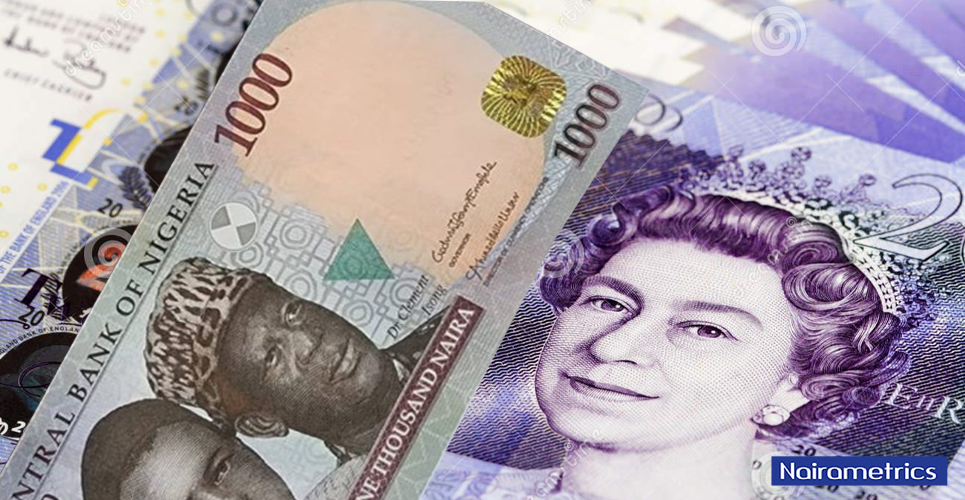
The British pound maintained a steady position against the Nigerian naira on 5 January, extending the stability recorded a day earlier despite lingering pressures within the foreign exchange market.
Figures published by the NGNToday platform indicate that the pound continued to exchange at N1,925 at the official window and N1,995 at the parallel market, unchanged from rates observed on 4 January.
The absence of movement in both segments of the market suggests a temporary balance between demand and supply, even as broader structural challenges continue to weigh on the naira.
Currency analysts say the steady performance reflects cautious trading behaviour, with market participants adopting a wait-and-see approach amid expectations of further policy signals from monetary authorities.
At the official end of the market, the pound’s stability is largely attributed to controlled allocations and the Central Bank of Nigeria’s ongoing efforts to manage foreign exchange flows.
Although access to foreign currency remains selective, especially for non-priority sectors, the lack of sudden demand surges has helped prevent short-term volatility. For businesses with approved access, the stable rate offers brief relief and predictability in planning cross-border transactions.
In the parallel market, the pound’s steady trading at N1,995 points to a slowdown in speculative activity.
Traders note that while demand for the British currency remains strong, driven by overseas education costs, travel expenses, medical bills, and imports, the market has adjusted to prevailing price levels. As a result, buyers and sellers appear to have settled around an accepted range, reducing abrupt price movements.
Economic observers caution, however, that stability at elevated levels does not necessarily signal strength for the naira. Instead, it reflects an equilibrium shaped by constrained supply and persistent demand.
Nigeria’s continued dependence on imports, combined with limited foreign exchange inflows from non-oil exports, means pressure on the local currency remains intact beneath the surface.
The performance of the pound also mirrors global dynamics. As one of the world’s major reserve currencies, the British pound often benefits from international capital flows, which can amplify its strength against emerging market currencies like the naira. Local analysts add that any shifts in global interest rate expectations or geopolitical developments could quickly alter current market calm.
For households and businesses, the steady exchange rate brings mixed implications. While predictability helps reduce short-term uncertainty, the wide gap between formal and informal market rates continues to influence pricing decisions.
Import-dependent businesses, in particular, face elevated costs when sourcing foreign currency outside official channels, costs that frequently translate into higher prices for goods and services.
Monetary authorities have reiterated commitments to reforms aimed at improving transparency and deepening liquidity in the foreign exchange market.
Measures to attract foreign investment, boost diaspora remittances, and strengthen export earnings are widely viewed as critical to achieving lasting currency stability. Analysts stress that without meaningful progress in these areas, periods of calm may remain fragile and short-lived.
As of 5 January, NGNToday data confirm that the British pound is holding steady at N1,925 at the official market and N1,995 in the black market, unchanged from 4 January. Market participants will continue to monitor policy developments and global economic trends for indications of whether this stability can be sustained in the days ahead.
For More Details, Visit New Daily Prime at www.newdailyprime.news

