



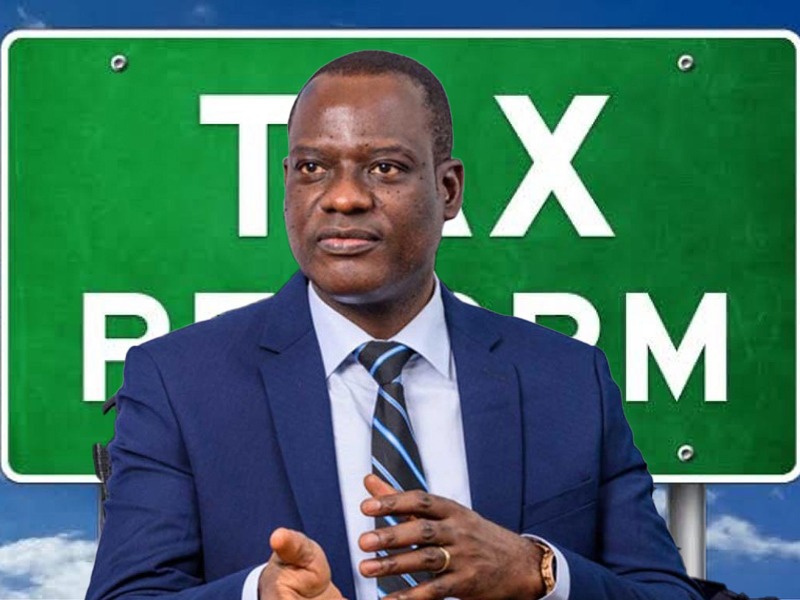
The Presidential Fiscal Policy and Tax Reforms Committee has issued a rebuttal to claims that Nigeria’s upcoming tax laws will cripple the aviation industry.
Instead, the government maintains that the reforms are specifically designed to dismantle the long-standing financial burdens—such as multiple levies and non-recoverable taxes—that have historically stifled airline operations.
In a statement released on Monday on his X page, Committee Chairman Taiwo Oyedele addressed industry concerns, asserting that the new framework provides the structural relief necessary to lower operating costs and stabilize ticket prices for the banking year 2026.
READ ALSO: Tax reform success depends on states, not federal laws – Sanwo-Olu
One of the most significant shifts under the new Nigerian Tax Act is the removal of the 10% Withholding Tax (WHT) on aircraft leases.
Previously, airlines were to pay millions of dollars in non-recoverable tax on leased fleets—for example, $5 million on a $50 million lease.
The new law replaces this fixed rate with a flexible regulatory framework, creating a legal basis for full exemptions or lower rates, which the government believes will immediately improve cash flow for domestic carriers.
The Committee clarified that while the 2020 COVID-era VAT suspension seemed helpful, it prevented airlines from claiming “input VAT” on assets and consumables, effectively embedding those costs into their operations.
Under the 2026 reform, airlines are entitled to full VAT neutrality, allowing them to reclaim all value-added tax paid on imported or locally procured spare parts, engines, and related services.
The law also mandates that any excess input VAT must be refunded within 30 days, with the process backed by a dedicated tax refund account.
In addition, airlines are permitted to offset accumulated VAT credits against other tax liabilities, a move expected to directly improve liquidity across the sector.
Addressing fears that a 7.5% VAT on tickets would lead to astronomical fare hikes, the Committee provided a “worst-case scenario” breakdown. Even if input VAT were not claimable, the maximum impact on a ticket would strictly be 7.5%.
A product currently priced at ₦125,000 is projected to rise to ₦134,375 after the inclusion of 7.5% VAT. Similarly, an item selling for ₦350,000 is expected to increase to ₦376,250 when the same VAT rate is applied.
The Committee noted that since input VAT is now fully recoverable, the net impact on final ticket prices is expected to be lower than these headline figures.
The new laws also propose a reduction in Corporate Income Tax (CIT) from 30% to 25%.
Furthermore, several fragmented levies—including the Tertiary Education Tax, NASENI, and Police levies—have been consolidated into a single Development Levy, reducing the administrative complexity that has long frustrated airline operators.
READ ALSO: NIN, CAC now serves as Tax ID for Nigerians, FIRS cllarifies ahead of 2026 tax reorms
While acknowledging the “multiplicity of levies” imposed by various agencies, Oyedele clarified that these were not created by the new tax laws.
However, the harmonisation provisions mean the situation is legally positioned to improve starting January 1, 2026.
The Presidential Committee urged industry stakeholders to base their concerns on facts rather than speculation.
“The new tax laws are not the problem; they are a critical part of the solution,” the statement concluded, reaffirming the government’s commitment to sustaining engagements with airline operators to resolve any remaining non-tax challenges.
For more details, visit New Daily Prime at www.newdailyprime.news

