



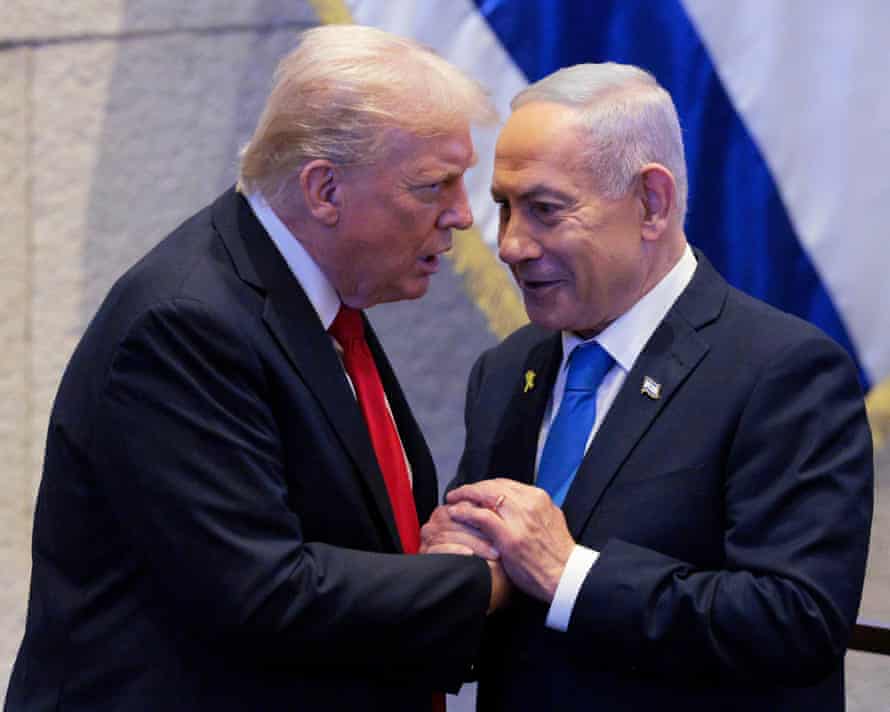
Benjamin Netanyahu is due to meet Donald Trump at the US president’s Mar-a-Lago resort in Florida on Monday evening, amid growing concern that Israel could launch new military offensives against regional adversaries, further destabilising the Middle East.
The Israeli prime minister left Israel on Sunday for his fifth visit to see Trump in the United States this year.
A central focus of the talks will be the Gaza ceasefire, which came into force in October and brought an end to a devastating two-year war. While the initial phase of the agreement has largely been implemented, serious obstacles remain to advancing the second stage of Trump’s 20-point plan.
Israeli forces have redeployed to new positions and Hamas has released all living hostages and all but one of those confirmed dead. However, the next phase of the deal has stalled amid mutual accusations of violations.
There are also fears Israel could resume hostilities against Hezbollah in Lebanon, breaching a ceasefire that has held for more than a year, or carry out strikes against Iran. Israel accuses Tehran of accelerating the production of ballistic missiles in recent months.
Gershon Baskin, co-head of the peace-building commission at the Alliance for Two States and a former back-channel negotiator with Hamas, said the timing of Netanyahu’s visit was “very significant” for Gaza.
“Phase one is basically over. There is one remaining Israeli deceased hostage, which Hamas says it is struggling to locate,” he said.
Baskin said Hamas had failed to commit to disarmament and had reasserted control over populated areas of Gaza, while Israel appeared unwilling to withdraw from the 53% of the territory it now controls or to allow unrestricted aid deliveries.
“Phase two has to begin,” he said, adding that Washington was increasingly concerned Hamas had been given time to rebuild its presence.
More than 70,000 Palestinians, mostly civilians, were killed during the war, and nearly all of Gaza’s 2.3 million residents were displaced. Since the ceasefire began, about 400 Palestinians have died, while widespread hardship continues.
Recent heavy rain and cold weather have worsened conditions in Gaza, where much of the housing and infrastructure has been destroyed or severely damaged.
The conflict began with a surprise Hamas attack on southern Israel in 2023, in which 1,200 people, mostly civilians, were killed and about 250 abducted.
Under the next stage of Trump’s plan, Gaza would be governed by a temporary authority made up of nonaligned Palestinian technocrats, replacing Hamas. An international stabilisation force of several thousand troops would also be deployed. US officials have indicated the composition of the new authority could be announced in January.
On Friday, Axios reported that senior Trump officials were growing frustrated, saying Netanyahu had taken steps that undermined the ceasefire and delayed progress towards peace.
“There are more and more signs that the American administration is getting frustrated with Netanyahu,” said Yossi Mekelberg, a Middle East analyst at Chatham House. “The question is what it will do about it, because phase two is going nowhere.”
Netanyahu is also expected to press Trump to allow Israel to act against Iran’s nuclear and missile programmes, following damage inflicted during a brief conflict involving Israel and the US earlier this year.
Iran’s president, Masoud Pezeshkian, said on Saturday that his country was engaged in a full-scale war with the US, Israel and Europe, describing the situation as more complex than the Iran-Iraq war.
Discussions at Mar-a-Lago are also expected to include stalled efforts to reach a security agreement between Israel and Syria, as well as calls for stronger measures to disarm Hezbollah in line with the 2024 Lebanon ceasefire.
With an election due within 10 months, Netanyahu’s political future will weigh heavily on his agenda. Polls suggest his coalition would struggle to retain power if voting were held now, amid public anger over security failures, military service exemptions for ultra-Orthodox men and a series of political scandals.
Analysts say a close relationship with Trump could bolster Netanyahu’s standing among voters, making any public disagreement between the two leaders unlikely.
Netanyahu is also expected to seek assurances that Israel will retain its military technological edge. Israeli officials were unsettled earlier this year when Trump said he would permit the sale of F-35 fighter jets to Saudi Arabia, a move that would erode Israel’s exclusive access to the advanced aircraft.

