


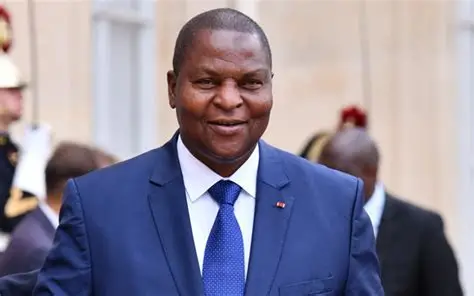
The Central African Republic will go to the polls on Sunday, with President Faustin-Archange Touadéra seeking a third term in office.
About 2.3 million registered voters are expected to take part in what observers describe as a quadruple election, covering the presidency, parliament, and local and municipal councils.
Seven candidates are contesting the presidency. They include former prime ministers Anicet Georges Dologuélé and Henri-Marie Dondra, who were cleared to run by the constitutional court after initially being barred. Dologuélé finished second in the presidential races of 2015 and 2020, while Dondra previously served under Touadéra.
Opposition figures are hoping to capitalise on public frustration in a country where insecurity remains widespread. More than 500,000 people are internally displaced, with a similar number living as refugees in neighbouring states.
Despite these challenges, Touadéra, a former mathematics professor who has been in power since 2016, is widely expected to win another term.
He entered politics after being appointed prime minister in 2008 by then-president François Bozizé. Touadéra remained in the role until 2013, when Bozizé was overthrown by a rebel coalition, triggering a civil war marked by sectarian violence.
After a turbulent three-year transition, Touadéra ran for president. His image as a neutral figure, unaligned with either the ex-Séléka or anti-Balaka militias, helped secure his victory in the second round.
In April, the government signed a peace agreement with the two main rebel groups, raising hopes of gradual stabilisation. Lewis Mudge, central Africa director at Human Rights Watch, said there had been “tangible progress” towards peace.
Abdou Abarry, head of the UN regional office for central Africa, echoed that assessment but warned challenges remained. Speaking to the UN security council this month, he said the country was laying the foundations for peace while taking steps to secure its borders, particularly with Chad and Cameroon.
Concerns persist that violence and supply-chain disruptions could affect voting, especially in rural areas. The UN peacekeeping mission Minusca, whose mandate has been extended until next year, is providing security and logistical support in place of the state’s weakened infrastructure.
Opposition groups have raised complaints about the electoral process, including claims that voter lists were published only online despite limited access to electricity and the internet. Several opposition politicians have announced a boycott.
Mudge warned that such irregularities risk disenfranchising large parts of the population and undermining the credibility of the vote.
There are also fears that another Touadéra term could deepen foreign influence in the country. A constitutional referendum in 2023 removed presidential term limits and extended mandates from five to seven years.
Touadéra has relied heavily on the Russian mercenary group Wagner, which provides part of his personal security, alongside Minusca and Rwandan forces deployed across the country. Since Wagner’s arrival in 2018, its influence has expanded, and the president has resisted pressure from Moscow to fold the group into Africa Corps, its successor organisation.
Rwanda has taken a different approach, focusing on smaller-scale business interests. In August, a pro-opposition media outlet reported that government forces had been removed from a World Bank-funded youth training centre near Bangui to make way for a livestock farming project involving Rwandan troops.
An editorial accompanying the report accused the government of sacrificing the country’s future in pursuit of foreign partnerships.
