


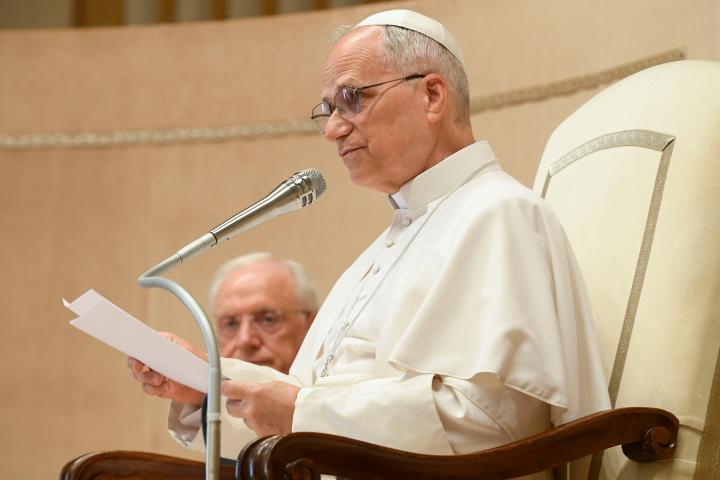
Pope Leo XIV on Thursday appealed to Russia and Ukraine to summon the “courage” needed to engage in direct negotiations, while also drawing attention to the worsening humanitarian crisis in Gaza, as he delivered his first Christmas message as pontiff.
The US-born pope, elected in May after the death of Pope Francis, used the occasion to denounce the devastation of war, describing it as senseless and leaving behind “rubble and open wounds.”
Speaking before an estimated 26,000 faithful gathered in St Peter’s Square, Leo urged Europeans to show “solidarity with and acceptance of those in need,” remarks widely seen as a subtle response to growing anti-immigration sentiment across the continent.
Turning to Eastern Europe, he said, “Let us pray in a particular way for the tormented people of Ukraine,” adding that peace would require political will and dialogue.
“May the parties involved, with the support and commitment of the international community, find the courage to engage in sincere, direct and respectful dialogue,” the pope said.
The war in Ukraine, triggered by Russia’s invasion in February 2022, has claimed tens of thousands of lives, devastated large parts of the east, and displaced millions.
While Russian and Ukrainian officials have separately engaged with US mediators in recent weeks, progress has been limited. President Volodymyr Zelensky recently outlined proposals aimed at ending the conflict, but President Vladimir Putin has shown little sign of compromise.
In his Christmas homily, Pope Leo also reflected on the dire situation in Gaza, where many residents remain in makeshift shelters amid cold, wet winter conditions, weeks after a fragile ceasefire.
“How… can we not think of the tents in Gaza, exposed for weeks to rain, wind, and cold?” he asked, noting that the people there “have nothing left and have lost everything.”
The United Nations estimates that about 1.3 million people in Gaza are in need of shelter support, warning that dropping temperatures are increasing the risk of hypothermia.
Speaking after attending Christmas mass at Gaza’s only Roman Catholic church, Palestinian Christian Elias al-Jalda described the toll of the conflict.
“The war, in all its forms, has been harsh on everyone living on this land,” he said.
“We hope this year will mark the beginning of a new phase – one defined by a complete end to the war and the return of life to Gaza.”
In Bethlehem, celebrations returned after more than two years, as the West Bank city marked its first relatively festive Christmas since the outbreak of the Gaza war. Hundreds gathered at the Church of the Nativity on Wednesday night, while crowds filled Star Street and the town square.
“Today is full of joy because we haven’t been able to celebrate because of the war,” said 17-year-old Milagros Anstas.
The streets were lined with vendors dressed as Santa Claus selling sweets and toys, as families posed for photographs near a nativity scene beneath a giant star. Manger Square glowed with colourful lights, and a large Christmas tree stood beside the Church of the Nativity.
In Syria, Christmas decorations lit up Damascus’s Old City despite lingering fears among Christian communities following a deadly attack earlier this year. Trees adorned with red ornaments, festive shop displays, and vendors selling roasted chestnuts added to the atmosphere.
“Syria deserves joy, for us to be happy and to hope for a new future,” said 20-year-old student Loris Aasaf.
Elsewhere, Christmas messages reflected sharply different national moods. In the United States, President Donald Trump extended greetings “to everyone, including the radical left-wing scum,” in reference to Democrats. Meanwhile, severe weather in California disrupted festivities, leading authorities in Los Angeles to declare a state of emergency and order evacuations.
In Australia, Prime Minister Anthony Albanese struck a sombre tone following a deadly attack during a Hanukkah celebration at Sydney’s Bondi Beach earlier this month.
“After the terror inflicted on Jewish Australians celebrating Hanukkah at Bondi Beach, we feel the weight of sorrow in our hearts,” he said.
