


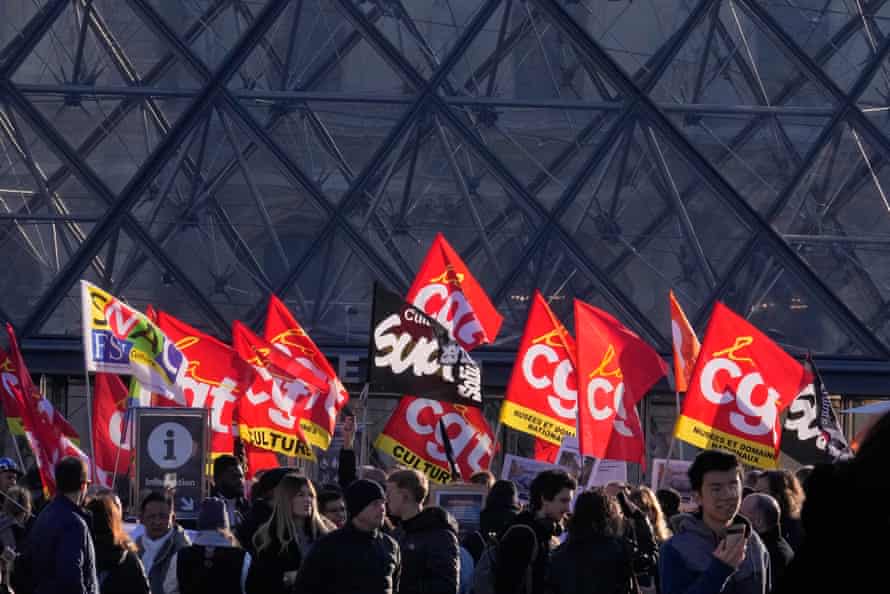
The Louvre museum in Paris was closed on Monday after staff went on strike to demand urgent renovations, increased staffing levels and improved security, while protesting against higher ticket prices for most non-EU visitors.
Workers also opposed plans to raise entry fees by 45% for visitors from outside the European Economic Area, including tourists from Britain and the United States.
The world’s most-visited museum could face several days of partial or full closure if members of its 2,100-strong workforce vote to continue strike action during one of the busiest periods of the year.
The strike follows a turbulent few months for the museum, marked by a major jewel heist, structural damage caused by a water leak and safety concerns over a gallery ceiling.
On 19 October, a four-person gang carried out a daylight raid on the Louvre, stealing French crown jewels worth an estimated €88m (£77m) in just seven minutes before escaping on scooters. Four suspects have since been arrested and placed under formal investigation, but the stolen jewels have not been recovered.
In November, a water leak damaged between 300 and 400 journals, books and documents in the Egyptian department. Soon after, a gallery containing nine rooms of ancient Greek ceramics was closed due to concerns about ceiling safety.
All three trade unions at the museum, GT, Sud and CFDT announced a rolling strike, warning that staff felt they were “the last bastion before collapse”.
The unions said the robbery exposed years of staff cuts and underinvestment by the state. The Louvre welcomed 8.7 million visitors last year.
Union representatives criticised plans to increase ticket prices for non-EU visitors as discriminatory. From January, visitors from countries including the UK, US and China will pay €32 to enter the museum.
Christian Galani, a CGT official, said it was unacceptable to ask certain visitors to pay more to visit a museum suffering from staff shortages and frequent room closures.
“These visitors will be paying more to see a dilapidated museum,” he said, adding that the policy went against the principle of equal access to culture. He contrasted the move with free entry to the British Museum.
Unions are also concerned about working conditions after 200 jobs were cut between 2015 and 2023, many of them in security roles.
Galani, who works nights in the security control room, said staff felt they had no other option but to strike. “There has been neglect of both building renovation and security measures to protect the collection,” he said.
Last month, France’s state auditor criticised the pace of security upgrades at the Louvre, describing them as “woefully inadequate” and accusing the museum of prioritising high-profile projects over protection.
Guy Tubiana, a senior police officer who took part in a post-robbery investigation ordered by the culture ministry, told senators he was “stunned” by the number of failures uncovered.
The investigation found a “chronic underestimation” of break-in risks and underinvestment in security, according to the culture minister, Rachida Dati.
Philippe Jost, who led the restoration of Notre-Dame Cathedral after the 2019 fire, is due to begin a study next month into a possible “deep reorganisation” of the Louvre.
The museum’s director, Laurence des Cars, has repeatedly warned about overcrowding and the cost of maintaining the former royal palace. In January, she described visiting the Louvre as a “physical ordeal”.
President Emmanuel Macron has since announced plans for a new museum entrance and a dedicated room for the Mona Lisa.
