



President Bola Tinubu has announced a new comprehensive security and economic framework aimed at unlocking Nigeria’s vast marine and aquatic resources, positioning the blue economy as a major driver of national transformation.
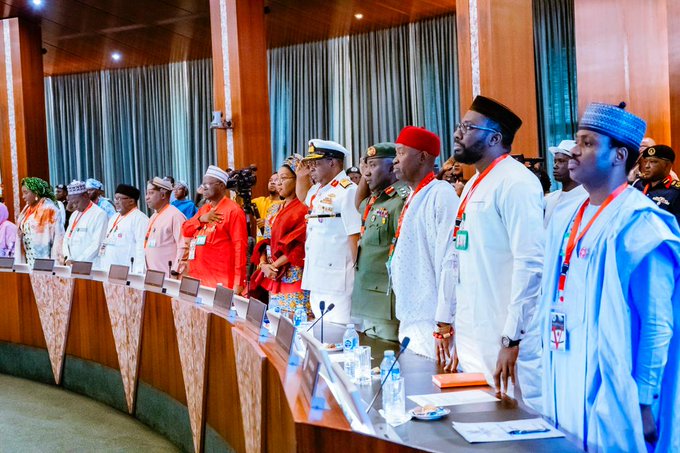
The President, represented by Vice President Kashim Shettima, unveiled the blueprint on Wednesday during a Presidential Parley with participants of the Senior Executive Course 47 of the National Institute for Policy and Strategic Studies (NIPSS) at the Presidential Villa.
Tinubu directed all relevant Ministries, Departments, and Agencies (MDAs) to immediately review and implement the recommendations of the NIPSS comprehensive study on blue economy development, titled “Blue Economy and Sustainable Development in Nigeria: Issues, Challenges and Opportunities.”
READ ALSO: Soyinka warns Tinubu over ‘excessive’ security escort for son, Seyi
“The blue economy offers a strategic pathway for diversifying our revenue base, creating sustainable employment and revitalising the ecosystems that sustain national development,” the President said, calling the NIPSS study a “timely resource.”
The administration is prioritising several key areas to leverage Nigeria’s 853-kilometre coastline and rich marine endowments: aquaculture expansion, port and maritime corridor modernisation, coastal tourism and marine biotechnology and renewable ocean energy.
The President highlighted the establishment of the Ministry of Marine and Blue Economy as a critical step toward improving port management and strengthening maritime security.
Acknowledging that economic ambitions in the marine sector depend on a safe and stable environment, Tinubu assigned NIPSS an expanded national security mandate.
The institute is directed to conduct a nationwide security diagnostic and develop actionable recommendations to guide reforms in Nigeria’s security architecture.
The President assured that the resulting policy paper would receive “the utmost attention.”
While noting that piracy has been reduced through the Deep Blue Project, the President warned that challenges like oil theft, illegal fishing, smuggling, vandalism, and kidnapping still undermine national revenues and investor confidence.
The NIPSS report, presented by Colonel Murkar Dauda, highlighted that while Nigeria has systemic gaps in governance and policy coherence, “Fisheries and aquaculture remain strong entry points.”
READ ALSO: Coup: Senate backs Tinubu’s request to deploy military to Benin
The report recommended that the Federal Government launch a national fisheries expansion programme leveraging private investment to increase fish production from the current 1.2 metric tonnes to 10 metric tonnes within two years, review and harmonize all legal, policy, and institutional frameworks on the marine and blue economy and develop a comprehensive marine and blue economy financing framework.
The Director-General of NIPSS, Ayo Omotayo, thanked the President for the support received for the Senior Executive Course 47.

