


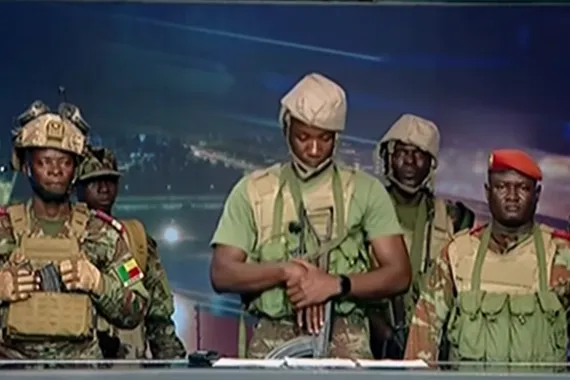
The opposition party in Benin – Communist Party of Benin (PCB) has openly criticised what it calls foreign military interference following the attempted coup d’état in Benin Republic on Sunday, December 7, 2025.
In a statement released on Monday, the opposition party said the failed coup and the events that followed have raised serious concerns about Benin’s sovereignty, warning that the country is drifting into external control under the guise of “defending democracy.”
According to the PCB, the attempt to overthrow President Patrice Talon was foiled largely through intervention by French forces stationed in Benin and airstrikes reportedly carried out by Nigerian fighter jets deployed from Lagos. The party insisted that such actions, if confirmed, constitute an unacceptable intrusion into Benin’s internal affairs.
The Nigerian government has also recently requested approval from its Senate to deploy troops to Benin, a request that has now been approved.
Although the PCB reaffirmed its longstanding rejection of military takeovers, it claimed that the political climate under Talon’s administration has created widespread discontent.
Read Also:
Benin Republic presidency: Talon safe as ‘loyal army’ moves to restore order
Coup attempt: Tinubu seeks Senate approval to deploy Nigerian troops to Benin Republic
“The Communist Party of Benin has always opposed putschism,” the statement said. “However, the December 7 coup attempt is a direct outcome of the disastrous governance of the ‘Rupture’ administration, characterised by predation, fascist dictatorship, exclusion, and repeated institutional coups since 2016.”
The party condemned what it described as Benin’s “monarchical Constitution,” accusing the Talon government of shrinking democratic space and silencing dissent. It warned that continued political repression would only increase the likelihood of future instability.
Allegations of French–Nigerian Military Collaboration
The PCB expressed outrage over reports, still unverified, that French President Emmanuel Macron requested Nigerian President Bola Tinubu to intervene under the ECOWAS framework. According to the party, Nigerian fighter jets supported French troops on the ground, while additional Nigerian ground forces were allegedly deployed through the Sèmè border.
“This event is extremely serious,” the PCB said. “It is an insult and humiliation to our political and military institutions. It amounts to turning Benin into a French colony under foreign supervision.”
The party demanded the immediate withdrawal of all foreign forces supposedly involved in the operation and insisted that Benin’s internal matters must be resolved without external interference. The statement, dated December 8 and signed by party leaders, has circulated widely on social media.
As New Daily Prime reported earlier, a faction of Benin’s military announced on national television on Sunday that it had seized power, dissolved President Talon’s government, and dismantled all state institutions. Identifying themselves as the “Military Committee for Refoundation,” the soldiers claimed they had removed the president and all political officeholders.
Gunfire was heard around the presidential residence, and armoured vehicles were seen patrolling key government areas. The presidency, however, dismissed the legitimacy of the group, describing them as “a small group controlling only the television station.” Officials insisted the regular army was regaining control and that “the city and the country are completely secure.”
President Patrice Talon, in power since 2016, previously announced he would step down in April 2026 after the next general election.
Benin now appears to be joining a growing list of West African nations engulfed in political upheaval. Guinea-Bissau’s armed forces took control last month following a disputed election, while Burkina Faso, Guinea, Mali, and Niger have all experienced coups since 2020. The region continues to face democratic backsliding, rising insecurity, and complex foreign involvement.
Despite the confusion surrounding Sunday’s events, Benin’s presidency insists President Talon remains safe and that loyal security forces are working to stabilise the country.
For now, the question dominating political discourse remains unanswered: Did foreign powers, especially Nigeria play an active role in suppressing the coup, and what does this mean for Benin’s sovereignty going forward?

