


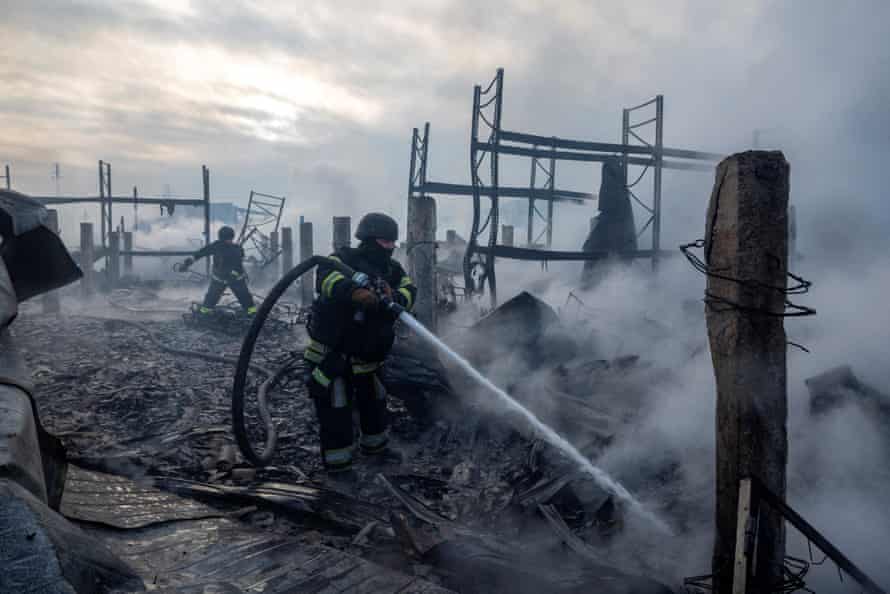
Russia carried out one of its largest aerial assaults on Ukraine in recent months, unleashing more than 650 drones and 51 missiles overnight on Saturday. The strikes came as American and Ukrainian officials met in Miami for continued negotiations aimed at ending the nearly four-year-old conflict.
Ukraine’s armed forces reported that the attacks targeted locations across the country, including western regions far from the frontlines. Air raid sirens also sounded in parts of eastern Poland, raising concerns about spillover effects of the war into NATO territory.
Authorities in Kyiv confirmed that at least three people were injured in the capital region. The national energy operator, Ukrenergo, said the majority of the strikes were directed at power stations and other energy infrastructure. Russia has intensified its campaign against Ukraine’s energy grid in recent weeks, seeking to deprive civilians of heat, light, and water as winter sets in.
Moscow’s defense ministry claimed it had intercepted 116 Ukrainian drones over Russian territory during the same period. Meanwhile, unverified reports on Telegram suggested that Ukrainian forces had struck an oil refinery in Ryazan, southeast of Moscow. The regional governor said debris from drones damaged a residential building and fell on an industrial site.
The escalation coincides with diplomatic efforts led by Washington. President Donald Trump has expressed determination to broker an end to the war, but progress remains elusive. Negotiations between U.S. and Ukrainian officials entered their third day in Miami on Saturday. Earlier in the week, Russian President Vladimir Putin met in Moscow with American real estate developer Steve Witkoff and Trump’s son-in-law Jared Kushner, underscoring the unusual mix of figures involved in the talks.
Washington’s proposals reportedly involve Ukraine ceding territory in exchange for security guarantees. Such terms would be politically difficult for Kyiv to accept, given the scale of destruction and loss of life endured since Russia’s invasion in 2022. There is also little indication that Moscow is prepared to sign a deal on Trump’s suggested framework.
U.S. Vice President JD Vance acknowledged the challenges in an interview with NBC on Friday. “The Russia-Ukraine thing has been a source of perennial frustration, I think, for the entire White House,” he said. Vance added that the administration had underestimated the complexity of resolving the conflict.
European allies have been caught off guard by Washington’s latest initiatives. Several governments are scrambling to remain engaged in the process, wary of being sidelined. On Saturday, the European Union’s foreign policy chief, Kaja Kallas, sought to downplay tensions. Speaking at a diplomatic conference in Qatar, she emphasized the enduring importance of transatlantic ties despite differences.
“The U.S. is still our biggest ally,” Kallas said. “I think we haven’t always seen eye to eye on different topics, but I think the overall principle is still there. We are the biggest allies and we should stick together.”
Her remarks followed the release of the Trump administration’s new national security strategy, which warned that Europe faced “civilisational erasure” due to immigration and suggested that Washington should support right-wing movements on the continent. The document has unsettled many European leaders, who fear it signals a shift in U.S. priorities away from traditional multilateral cooperation.
For Ukraine, the latest wave of Russian strikes underscores the urgency of securing reliable international support. The attacks on energy facilities threaten to plunge millions into darkness and cold as the country braces for another harsh winter. With negotiations in Miami showing little sign of breakthrough, the war appears set to grind on, leaving both the battlefield and the diplomatic arena fraught with uncertainty.

