


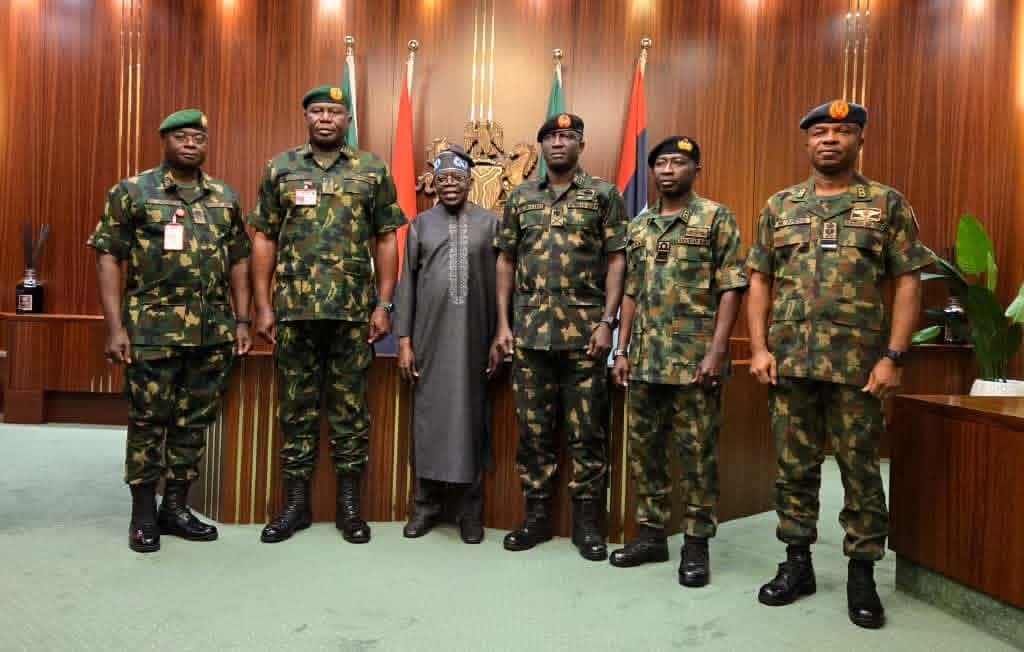
President Bola Tinubu is currently holding a high-level security meeting at the State House, Abuja, with top military and intelligence officials following growing concerns over national security.
The closed-door meeting, which began around 2:00 p.m. on Monday, is the first major engagement on the President’s schedule since his return to Abuja from Bayelsa State last Friday.
Those in attendance include the Chief of Defence Staff, the Chiefs of the Army, Navy and Air Force, the Inspector-General of Police, Tunji Disu, as well as the heads of key intelligence agencies, including the Department of State Services and the National Intelligence Agency. The National Security Adviser, Nuhu Ribadu, is also present at the meeting.
The emergency session comes amid heightened security tensions in the country, including the recent decision by the United States to authorise the voluntary departure of non-essential embassy staff from Abuja. The move followed what the US State Department described as a “deteriorating security situation” in parts of Nigeria.
The advisory also placed several Nigerian states under a “Do Not Travel” warning, citing threats from insurgent groups in the North-East, criminal gangs in the North-West, and ongoing violence in other regions of the country. The US Embassy in Abuja has since suspended routine visa appointments, although its Lagos consulate continues limited operations.
In response, the Federal Government maintained that the advisory was based on internal US protocols and did not reflect the overall security situation in Nigeria. Officials insist that most parts of the country remain stable despite isolated incidents of insecurity.
The security meeting is also taking place in the aftermath of a controversial Nigerian Air Force operation in Borno State that reportedly resulted in the deaths of over 100 civilians. The strike, which targeted what the military described as terrorist positions along the Borno-Yobe axis, has sparked widespread criticism.
While the military has maintained that the operation was aimed at Boko Haram elements, human rights organisations, including Amnesty International, have alleged that a civilian market was struck, resulting in significant civilian casualties. The Air Force has not directly addressed claims that civilians were among those affected.
The Presidency, however, has defended the operation, with presidential spokesperson Temitope Ajayi stating that the target was considered a legitimate military objective due to alleged terrorist activity in the area.
Amnesty International has called for an independent investigation into the incident, describing it as part of a troubling pattern of civilian harm in military operations. Reports have indicated that hundreds of civilians have been killed in similar air raids since 2017, often due to intelligence or coordination challenges.
Nigeria continues to grapple with multiple security threats, including insurgency in the North-East, banditry and kidnappings in the North-West and North-Central regions, and separatist violence in the South-East. Recent months have also seen mass abductions and deadly attacks across several states, further intensifying public concern.
As of the time of reporting, the security meeting was still ongoing within the Presidential Villa, with official vehicles of the security chiefs seen parked at the forecourt of the President’s office.
