


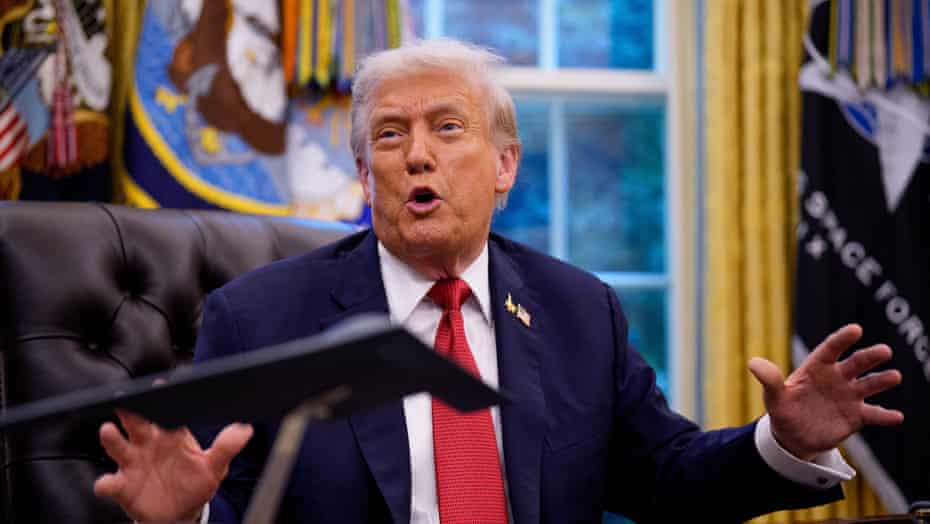
President Donald Trump has directed all United States government agencies to immediately discontinue the use of artificial intelligence technology developed by Anthropic, following a major disagreement between the AI firm and the Pentagon over military applications of its Claude models.
The directive came after Anthropic declined a demand from the United States Department of Defense requiring unrestricted military access to its technology, including potential deployment for surveillance and autonomous weapons systems.
In a statement released Friday, the company condemned what it described as pressure tactics by defence authorities, insisting it would not permit its systems to be used for large-scale domestic monitoring or fully autonomous combat operations.
“No amount of intimidation or punishment from the Department of War will change our position on mass domestic surveillance or fully autonomous weapons,” Anthropic said.
Responding to the standoff, Trump announced a sweeping federal ban on the company’s technology through a post on his Truth Social platform.
“I am directing EVERY Federal Agency in the United States Government to IMMEDIATELY CEASE all use of Anthropic’s technology. We don’t need it, we don’t want it, and will not do business with them again!” Trump said.
He further warned the company against resisting the transition process.
“Anthropic better get their act together, and be helpful during this phase out period, or I will use the Full Power of the Presidency to make them comply, with major civil and criminal consequences to follow,” he added.
The Pentagon had earlier issued an ultimatum requiring Anthropic to accept its conditions by Friday evening or face enforcement measures under the Defense Production Act — a Cold War-era law granting Washington broad authority to compel private industry cooperation for national security purposes.
Officials also threatened to classify Anthropic as a supply chain risk, a designation typically applied to firms considered security threats.
Rejecting the move, the San Francisco-based company said it would challenge any such designation in court.
“We will challenge any supply chain risk designation in court,” Anthropic stated, warning that certain applications of artificial intelligence could erode democratic principles rather than strengthen them.
“In a narrow set of cases, we believe AI can undermine, rather than defend, democratic values,” the company added.
US Defense Secretary Pete Hegseth confirmed that the Pentagon would proceed with restrictions, announcing that companies working with the US military would be barred from maintaining commercial ties with Anthropic.
“Anthropic delivered a master class in arrogance and betrayal as well as a textbook case of how not to do business with the United States Government or the Pentagon,” Hegseth wrote on X.
The dispute has sparked political and industry-wide reactions. House Democratic leader Hakeem Jeffries criticised the Pentagon’s position while praising Anthropic’s resistance.
“Mass surveillance of American citizens is unacceptable,” Jeffries said, describing the situation as a troubling intrusion into civil liberties.
The confrontation has also drawn support from employees across major technology firms, including OpenAI and Google DeepMind, whose staff jointly signed an open letter urging industry unity against demands permitting surveillance or autonomous lethal decision-making.
The letter warned that companies risk being pressured individually into compliance if they fail to present a united stance.
Meanwhile, OpenAI chief executive Sam Altman reportedly told employees he was seeking a compromise framework with the Pentagon that would maintain safeguards similar to those proposed by Anthropic.
“We have long believed that AI should not be used for mass surveillance or autonomous lethal weapons, and that humans should remain in the loop for high-stakes automated decisions,” Altman wrote in an internal memo cited by US media.
Despite the escalating dispute, Anthropic said it remains open to cooperating with national security authorities under ethical boundaries, reiterating its willingness to support US defence efforts without compromising democratic values.
