


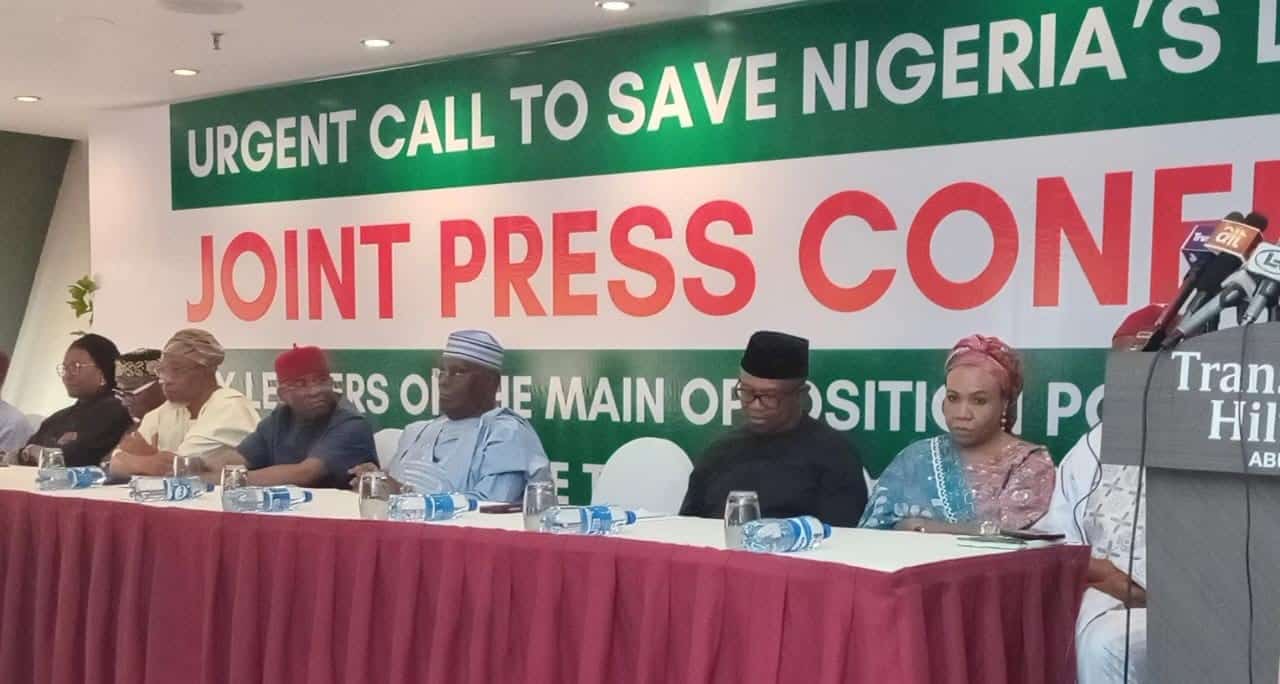
The African Democratic Congress (ADC) and the New Nigeria Peoples Party (NNPP) have rejected the newly amended Electoral Act 2026, warning that the legislation threatens Nigeria’s democratic framework and could entrench one-party dominance.
President Bola Tinubu signed the Electoral Act 2026 into law on February 18 after its passage by the national assembly. However, opposition leaders say the process and substance of the amendment raise serious concerns.
Addressing journalists in Abuja on Thursday, NNPP National Chairman, Ajuji Ahmed, spoke on behalf of a coalition of opposition parties. He accused the ruling Bola Tinubu-led administration and the All Progressives Congress (APC)-dominated national assembly of rushing the legislation through with the intent to weaken political competition.
According to him, the amendment was passed with “contemptuous haste” to “weaken opposition, corrupt the electoral system, compromise democratic institutions and foist a totalitarian one-party rule on Nigeria.”
Ahmed said the opposition would pursue all lawful and constitutional mechanisms to resist the implementation of the Act.
“We therefore state unequivocally that the new Electoral Act is anti-democratic, and its implementation will undermine electoral transparency and sanctity of the ballot which are fundamental to free, fair and credible elections and the bedrock of participatory democracy,” he said.
He further described the legislation as part of a broader strategy by the APC to erode democratic safeguards.
“This obnoxious Electoral Act, 2026 is without doubt enacted to undermine democracy in Nigeria and it is part of the on-going design by the Tinubu-led APC to disorganize and weaken opposition, corrupt the electoral system, compromise democratic institutions and foist a totalitarian one-party rule on Nigeria.
“Therefore, we, as patriotic leaders, standing shoulder to shoulder with Nigerians, reject the new Electoral Act for the following reasons.
“We demand that the national assembly immediately commence a fresh amendment to the Electoral Act 2026, to remove all obnoxious provisions and ensure that the Act reflects only the will and aspiration of Nigerians for free, fair, transparent and credible electoral process in our country. Nothing short of this will be acceptable to Nigerians.”
The NNPP chairman also faulted the national assembly for allegedly disregarding stakeholder input during public hearings on the bill. He said “well-thought-out and well-considered clause-by-clause recommendations from stakeholders and citizens across the country” were ignored, adding that “the will of the people were eventually subverted and their views rubbished.”
Ahmed praised opposition lawmakers who resisted what he termed anti-democratic provisions, while cautioning others whom he accused of prioritising personal interests over public good.
He warned that “the people are watching and taking note” and that “at the appropriate time, the people would remember those who stood in defence of their democratic aspirations and those who sold the will of the people for a mess of pottage.”
Beyond the Act itself, the opposition leaders also alleged that the recent Federal Capital Territory (FCT) area council elections served as a rehearsal for broader electoral manipulation ahead of 2027, describing the exercise as a “test-run of 2027 APC rigging plan.”
Among prominent figures present at the press conference were former Vice-President Atiku Abubakar; Peter Obi, the 2023 presidential candidate of the Labour Party; and Rotimi Amaechi, former minister of transportation.
Also in attendance were David Mark, national chairman of the ADC, and Rauf Aregbesola, the party’s national secretary.

